|
|
January 15, 2013
 Helping Others? Game ON! We all say we want to live in a community where people care about their neighbors – not only when we’re in desperate need, but every day. Because the every day stuff is what makes up your life and mine, and that couple across the street. (What’s their name?)
There are countless ways to show we care and most of them are ridiculously simple. Like noticing that kid nervously waiting on the curb when you come to a stop. What does it take to make eye contact with him, smile, and let him know he can “Go ahead” and cross safely in front of your car? Not a whole lot. It also doesn’t take much to notice that those people seem to be looking for something on the ground. You could easily get up and ask if they’ve lost something and could they use another pair of eyes in their search. It takes a little time. A little effort. When people do stuff like that it says that ours is a caring community. When they don’t or we don’t, it says something else.
I’ve just started reading Peter Lovenheim’s In The Neighborhood: The Search for Community on an American Street, One Sleepover at a Time. I’m only on page 70, but I already recommend it, in case you want to check it out. You might also want to check out what’s going on in your community on Monday. No sleepovers are required, but stuff is happening, I guarantee it.
Monday, January 21st, is Martin Luther King, Jr. Day and since 1994, when Congress had a great idea and actually acted on it, MLK Day has been a National Day of Service. So if you and your family have time off on Monday and you’re interested in moving beyond shaking your head to doing something to make your community a more caring place, go to MLK.gov and Find a Project.
I just did that by typing in my zip code. Within a 25 mile radius I found dozens of community volunteer opportunities for this Monday. A beach clean up project. A neighborhood park needing help with invasive plant removal. This one, from the Human Rights Commission, caught my eye: We will need volunteers to assemble care bags for LGBT homeless youth. Helping kids? Yes! I can do that! Sign me up!
What can you do? Find out what’s needed and where. It’s all good. It all helps. Start here.
NOTE: In January, 2009, David and I were in DC for Obama’s Inauguration. That year, on MLK Day we helped out with an amazing book project to benefit DC public schools. So gratifying to be of service!

December 31, 2012
I originally wrote this article for TakePart.com where I write a weekly education post. Check out the rest of my articles there.
 Homework doesn't make kids smarter, it mostly just keeps them busy and stresses them out The long holiday break is almost over. I hope you and your kids made the most of the delights of the season. And that includes time to relax together as a family, kids and parents, savoring the freedom from school assignments. Yes, I’m an educator, but I am no fan of homework. Especially not obligatory daily assignments that drill students on information and skills they’ve already mastered. Practice makes perfect. But over-practice makes for soul-crushing boredom and it turns kids off of education.
From my way of thinking, homework, if given at all, ought to be assigned sparingly. After all, kids have had a long day in class. They’re not machines. They need a break. And, yes, they need to play. Coming home from school every day to face a mountain of homework is dispiriting.
If a teacher assigns homework, students and parents ought to be confident that there’s a very good reason for the assignment, and a high likelihood that it will yield tangible benefits for the student. What kind of assignments are those? The ones that include:
- a creative challenge
- the opportunity to reinforce a new concept presented during class
- practice using the concept for problem-solving
The result? S-T-R-E-T-C-H-I-N-G the student’s mind and transforming a new idea into an Ah-ha! learning experience. When homework offers these opportunities kids respond eagerly because, as learners, they win. This makes them eager to learn more. (And if that isn’t the ultimate goal of education, I don’t know what is.)
The alphabet coloring homework sheets my son received for 26 weeks during his kindergarten year were busy work. There was no mind stretching during those coloring sessions. Though, as I recall, there was some healthy resistance and a pointed challenge: “Mom, why do I have to do this?”
Why indeed? Teachers aren’t sadists. They must believe homework benefits their students. But is that really the case? According to Alfie Kohn, educator, educational critic, and author of The Homework Myth, “…there is no evidence that… kids who have better grades and test scores have them because they’ve had to do more academic assignments after a full day in school. (Also) there isn’t a shred of evidence to demonstrate that homework has any nonacademic advantages, such as teaching self-discipline and responsibility or teaching kids good work habits.”
And yet the homework continues piling up and the stress it causes in kids, and in families, is heartbreaking. If it feels like your child is spending inordinate amounts of time on homework, here are some steps you might take:
1. Find out what your district’s homework policy is. The student handbook usually includes guidelines that describe how many minutes of homework per evening per grade level. Compare the guidelines to reality.
2. Talk with other parents whose kids have the same teacher as your child. Sometimes the issue is “too much homework.” When that’s the case, parents have the right and responsibility to talk with teachers and let them know the impact all those assignments are having at home.
3. Talk with your child’s teacher. Sometimes, the issue isn’t the amount of homework. Sometimes it’s your child’s ability to complete the assignment in a timely fashion. Ask your child’s teacher, “How much time did you expect that assignment to take?” If what you hear is: “10-15 minutes” and your child spent 45+ minutes, then you and the teacher may have a new topic of conversation. For example: “How can we work together to help this student (my child) be more successful and efficient in his/her work? Is an evaluation for learning differences an option we should consider?”
4. Down with busy work! If teachers are assigning homework that clearly falls into the Busy Work category, speak up to the teacher (calmly and respectfully, of course), to other parents, and at PTA meetings.
A child’s mind is a terrible thing to waste. So is a child’s time to relax, dream, and be a kid without the ever-present dark cloud of “homework” hanging over their heads.
Here’s wishing you and your family all the best in 2013, More laughter. More opportunities to help others. More creative inspiration. And less homework.
December 28, 2012
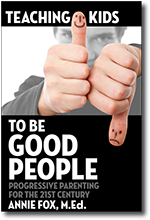
 FREE download for December 28-30, 2012, ''Teaching Kids to Be Good People'' by Annie Fox, M.Ed. Today (12/28) through Sunday (12/30), we’re giving away the Kindle version of my new parenting book Teaching Kids to Be Good People: Progressive Parenting for the 21st Century.
No Kindle? No problem. Download the ebook anyway because you can read it just fine on your PC, Mac, iPod Touch, iPhone, iPad, Android, Blackberry, and Windows Phone 7 with Amazon’s free Kindle Reader app.
Not in the US? Here are the Amazon links for Canada, UK, Australia, Brazil, France, Germany, Italy, Japan, Spain
Please accept this ebook as my gift to you and your family. Interested in the print edition? Learn more here.
Best wishes for a happy, healthy New Year, from our home to yours.
December 26, 2012
My friend and digital kids’ author, Karen Robertson, whose work includes the Treasure Kai series plus the Author’s Guide to Book Apps, contacted me about “The Next Big Thing.” Essentially it’s a “blog chain” for writers to help fellow writers get some buzz about their latest books and/or upcoming projects. Anything that helps me promote my work and simultaneously allows me to shine a light on other people’s writing sounds like a winner. “Sure!” I told Karen. “I’m in.”
She sent me 10 questions to answer. She’s linking to my blog from hers and, in turn, I’m supposed to link to the blogs of writers to whom I’ve reached out. Only one snag. At the moment, none of the 10 writers I’ve pitched the idea to have responded to me. I chalk it up as part of a well-deserved holiday slacker attitude. (Not even sure why I’m blogging today, except that I promised Karen and I’m big on keeping agreements.) When my writer friends get around to reading the email I sent them a week ago and decide to jump into The Next Big Thing, I’ll update this blog and link to their sites. In the meantime, here are my answers to the 10 questions. It was fun to answer them. Hopefully, you’ll find something interesting in what I have to say here.
 We can't parent without a game plan. Here's a good one. 1) What is the title of your latest book? Teaching Kids to Be Good People: Progressive Parenting for the 21st Century. It was published in October, 2012.
2) Where did the idea come from for the book? Well, we sure need more good people in the world. Can’t have too many of them… ever! But right at this point in history, I’d say we’re dealing with a world that is speedier, noisier, and in many ways more “I, Me, Mine” than ever before. Good people are desperately needed. Definition of a good person? Well, in my book… (and this is my book) a good person is one who looks for opportunities to do good in the world and has the social courage to act on those good intentions.
3) What genre does your book fall under? Non-fiction, parenting. But on a much broader level, this is a book about emotional intelligence and the tools to resolve issues from our own childhood so each of us may move forward toward a healthier relationship with ourself, our parents, our children, and everyone else. This may actually be a book about creating world peace. (Wow, that was a bigger answer than the “genre” question, wasn’t it?)
4) What actors would you choose to play the part of your characters in a movie rendition? I get that this question was devised for fiction writers, but I’ll take a sincere crack at it. Since the basis of my book is 32 personal essays, I’d say the best person to play the lead character in the movie rendition of Teaching Kids to Be Good People would have to be me. But I could totally do it! I was voted Class Actress in high school and I’ve done tons of community theatre. I already know all the lines, so I’m ready!
5) What is the one-sentence synopsis of your book? We desperately need more good people and they’re going to come from parents with a game plan. Teaching Kids to Be Good People is the game plan. (OK, that was two sentences. Sorry.) Here’s a free excerpt of Chapter 1, just to give you a taste of what this is all about.
6) Was your book self-published or represented by an agency? Electric Eggplant (which is my husband, David Fox, and me) published Teaching Kids… So, the answer is self-published. And I say that with no small amount of pride. The book looks and reads like the professional product it is.
7) How long did it take you to write the first draft of the manuscript? About a year, though many of the essays were originally written in other forms within the past five years. Two-thirds of the book is brand new content. Even with the “older” stuff, I had to get in there and re-work each essay because a) I’m a compulsive editor and b) I’m a better writer than I was when I first wrote them. I’ll be a better writer tomorrow than I am today. If I were to revisit this book a year from now, I’m sure I’d find ways to take it to still another level. But at some point you have to say, “This is good. I stand by it as is.” And then you put it out there in the world. I’m gratified by the enthusiastic reviews the book has received so far.
8) What other books would you compare this story to within your genre? There are hundreds of top-notch parenting books out there, with more coming to market each month. It’s a very competitive genre to be publishing in. Many of these books are written by MDs, and PhDs and are very helpful to very specific parenting challenges like: parenting kids with special needs, parenting adoptive kids from “hard” places, step-parenting, etc. My book is for all parents who recognize that their #2 objective (after keeping their children safe and healthy) is to help kids develop into people of good character.
9) Who or what inspired you to write this book? I’ve been answering email questions from tweens and teens since 1997. More and more of their questions reflect a huge gap in their understanding of how to treat themselves and others with compassion and respect. I wrote the book because kids have told me (in so many words) that they need tools to help them develop a moral compass. I wrote the book to help parents help their kids on their journey into young adulthood and beyond. A big part of the challenge parents have is in the area of communication. We wrongly assume that adults and kids mean the same thing when we use words like “fair” “mean” “love” “trust” “friendship.” That ain’t necessarily so. Parents need to do whatever it takes to get on the same page as their children (no small feat when our kids spend 24/7 mind-melded with their peers). My book offers parents new ways to see 21st century life from the eyes of their kids and provides guidelines to Conversations that Count. We need to listen to each other so a kid’s perspective is part of every parent’s frame of reference and a parent’s perspective is part of the mix inside a kid’s head when s/he is making choices amongst peers.
10) What else about the book might pique the reader’s interest? Read it and you’ll learn more about yourself and your kids. Then you’ll be able to use what you learn to be the kind of parent you have always wanted to be.
— Older Posts »
| |













 Facebook
 Twitter
