|
|
January 17, 2012
(See UPDATES BELOW)
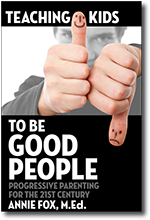
I’m writing my first book for adults since Armchair BASIC. It’s called: Teaching Kids to Be Good People. It will be available as an eBook in September.
Since one person’s “good” might be another person’s “Are you kidding me?!” I knew I needed to be precise from the onset. So I asked my twitter followers, plus many of my most thoughtful friends, colleagues and family members “How do you define a ‘good’ person?”
Lots of intriguing and insightful responses galloped my way and I’m grateful. My plan is to dissect each one… all in good time. But at the moment, I’m focused on forgiveness.
That’s an aspect of “goodness” I hadn’t considered. Probably says something about me. I mean, I have overstayed my welcome at the Self-Pity Party, ahem… once or twice. So when one especially kind-hearted friend offered me this nugget: “A good person is forgiving”, like a dog and a flying tennis ball, I was on it. Thinking. Thinking. Thinking.
- What does it mean to be forgiving?
- How do you actually forgive someone? Which muscle do you relax or clench?
- What’s the connection between forgiving and forgetting? Are they mutually exclusive?
- What might you gain by holding on to your resentment? Anger? Self-righteous indignation?
- What might you lose?
- Why is it so $#*@ hard to permanently unplug a memory that continues to wound each time you project it onto your mental movie screen?
These are open ended questions, my friends. I don’t know any useful answers… yet. Love to hear your thoughts.
fyi, in the next 6 months, I’ll be talking about teaching kids to be good people at the 18th Annual Character Education Conference in St. Louis, the INTASE Educators’ Conference in Singapore, and at the 19th National Forum on Character Education in Washington, DC.
_______________
UPDATE 3:13 pm Today (9/14/12): The book is finished! And I’ve had only enthusiastic early reviews, including these:
- “Annie Fox has a genuine passion for helping our young people and she has many years of experience doing it. Both are evident in this wonderful resource for parents and teachers. It’s full of insight, wisdom, good stories, and most important – practical advice. I highly recommend it for anyone wanting to help our kids become good people.” –Dr. Hal Urban, author of Life’s Greatest Lessons and 20 Gifts of Life
- I can’t express enough how much I love Annie’s work. Having worked in this field for so long, it becomes increasingly difficult to read new thoughts and ideas. Every time I read something of Annie’s, it makes me think. She writes about subjects with such compassion, insight and practicality that you can’t help but love all that she does. Great book-a great job Annie!” –Sarah Newton, author of Help! My Teenager is an Alien!
- “Another work of magic from what I have come to know as a master in the field. Sharing actual scenarios and follow up ideas, helps to keep readers connected to Annie’s ideas in a way that most parenting books fail to do.” –Joe Bruzzese, author of A Parents’ Guide to the Middle School Years and Founder of Sprigeo.com, the online bully reporting system
- “Finding positive, empathetic role models is often difficult but this wonderfully practical and warm hearted eBook is a great place to start. It will empower parents with some really helpful suggestions and ideas that will help you to navigate the choppy emotional waters of raising great adults.” –Sue Atkins, author of Parenting Made Easy – How to Raise Happy Children
This early feedback, especially coming from these excellent parent educators, has touched and encouraged me. The book is done, so what am I waiting for? Nothing, except to finalize the cover design. That won’t take long. As promised, before the sun sets on the last day of September 2012, Teaching Kids to Be Good People, will be available to everyone interested in raising young adults of good heart and mind. If you’d like to receive an announcement when the book is available, shoot me an email and I’ll let you know… personally.
_____________
UPDATE (10/3/12): I’m very pleased (and excited) to announce Teaching Kids to Be Good People is now available in print and also on Kindle. Here’s an excerpt from the introduction:
We parent-educators are gardeners. We plant seeds and offer nurturing lessons that our kids can internalize. But we are not our children’s only influencers. By re-dedicating ourselves to teaching our kids to be good people, we provide them with the tools to do the right thing while we’re right there beside them and when they’re on their own. Whether they actually do it, is their choice. But at least we’ll know we’ve done our part well.
To help on our parenting journey, I’ve written this very personal and pragmatic guide that includes essays, podcasts, prompts, tools, questions, answers and self-assessment quizzes all for the purpose of teaching kids to be good people. How do you define a “good person?” That’s what I wanted to find out, so I posted the question and received hundreds of answers. Eight words kept reappearing: Emotional intelligence, ethics, help, forgiveness, compassion, empathy, tolerance and social courage — all essential, teachable skills. This book will help you teach them to your children or students. Hopefully, we’ll become so engaged in this process that our teaching will inspire all of our children to become part of the solution.
Look for an announcement next month! In the meantime, if you’d like a personal email when the Teaching Kids to Be Good People is available, let me know.

December 29, 2011
Before I watched the sunset it was a normal Wednesday. David and I ate oatmeal and read the paper. I went on poop patrol in the yard. Drove to Spanish class. Filled up the car. And answered this email from a desperate teen:
Hey Terra,
I can’t take it much longer. I like this boy and he has known for about 1 week now. We’ve known each other since 2nd grade. I hate when he dates other people but mostly this one girl and he’s dating her again! He said he does things he don’t want to for her and she put him through hell last time. I hate this cause if it happens again I’m going to be hurting because I love him so much. What do I do?
Desperately in Love
I wrote back:
Dear D in L,
I understand that you love this guy and you’re very upset when he’s “put through hell” by his girlfriend. But there are two sides to this story. Let me tell you about the other one.
Nobody is forcing the boy to date this girl.
Nobody is forcing him to “do things for her” and nobody is forcing him to stay and put up with “the hell” you say she’s putting him through.
Maybe you think everything would be wonderful if he’d only see how perfect you are for him. But life doesn’t work that way. He makes his own choices and don’t let him try to convince you that someone else is controlling him.
If he wants to end it with his girlfriend, he will… if and when he’s ready.
If he wants to be with you or someone else, he will… if and when he’s ready.
I’m sorry you’re frustrated and hurting, but that’s can happen when you try to control a situation you have zero control over. If you’d like to feel better and more in control of your emotions, I have a suggestion. The next time the boy tells you about “the hell” his girlfriend is putting him through, you might encourage him to stand up for himself in this relationship. Of course, telling him is your choice. You’ll either do it or not.
And if you do, he’ll either take your advice. Or not.
I hope this helps.
In friendship,
Terra
Then I put the dog in the car and grinned at her reflection, joyously hanging out the window, sucking in all those end-of-the-year-in-Northern California smells.
A little ways down the road, we parked, climbed the hill and hiked along the ridge.
Then I saw this
 4:12:18 and this
 4:12:58 and this
 4:13:33 and this
 4:42:21 and…
 4:51:54
This word-junkie has nothing worth saying about what I saw. Only that there were two-sides of Wednesday. Before I watched the sunset and after.
December 8, 2011
Just read a headline in my morning San Francisco Chronicle. “$55,000 for pepper spraying of child.” Sounds a tad extreme. What could possibly cause a cop to use a toxic weapon on a kid?! Well, apparently, back in June 2010, a 7-year-old special education student from San Mateo (who, according to the story, has “learning difficulties, dyslexia, anxiety disorder and social-skill problems”) perched on an “unsteady” piece of classroom furniture and refused to get down. Classroom aides called the police. (Huh?!) An officer arrived with a can of pepper spray. (You’ve gotta be prepared facing a 2nd grader.) After warning the child that he’d be pepper sprayed if he didn’t get down by the count of five, the officer sprayed him. According to the filed complaint, the child didn’t know what pepper spray was. Guess that should now be included in the 2nd grade curriculum.
A quick search revealed that in April of this year, another elementary school student in a special education class was a pepper sprayed by police at his Denver school.
The two incidents could easily be lumped together, but they are very different.
In the Denver case, the child behaved violently, throwing furniture, wielding a broken piece of board, cursing and threatening to “kill” his teachers. The police reportedly felt the safety of the teachers and students was threatened and they needed to subdue that 8 year old quickly.
In the San Mateo incident, apparently the child was in danger of tumbling from a bookcase and they needed to subdue that 7 year old quickly.
I wasn’t at either scene, but I’m wondering: if a police officer doesn’t have the common sense and the training to safely get a 7 or 8 year old under control, then what the hell is that officer doing on the force?
I’m also wondering if this isn’t a case of “When all you’ve got is a can of pepper spray, then everyone looks like a dangerous suspect needing to be subdued quickly.”
Finally, I’m wondering what lessons the victims and rest of the kids in those two classrooms took home that day about police officers and teachers… adults who are supposed to care about kids and know how to take the time to listen to them, to understand and to help.
November 27, 2011
By Dr. Lyndsay Elliott
Dr. Elliott is a clinical psychologist and an eating disorder specialist in southern California. Learn more about her work here.
 "Self esteem" Mixed media by Alexa Van Daam A healthy body image means accepting and appreciating your body and feeling satisfied with your appearance. It also means being grateful for your body’s qualities and capabilities. Learning to love and respect your body is an important part of personal development and a major contributor to self-esteem. Once you connect to this inner confidence, while also letting go of unrealistic standards/expectations for what you think your body should look like, you can break free from not feeling _____ enough (thin, beautiful, young, firm!). You can then create a sense of self you can truly feel proud of. Without that, you leave yourself vulnerable to the development of disordered eating patterns, a poor relationship with food, depressive symptoms and low self-esteem.
The following list provides ways in which parents can promote a healthy self-image in their children. By utilizing these tips, parents can support their child’s self-esteem starting at an early age and establish a healthy body image. That will protect against the development of more serious eating disorders and body image issues.
1. Instill Confidence: When you comment on internal qualities you instill self-assuredness in your child. Use phrases such as, “You are really good at….” Or “You seem to really know…” Reward effort and completion, instead of outcome.
2. Encourage Movement: Find a physical activity that your child enjoys, and focus on how being active makes your child feel. Promote the health benefits of exercise, without emphasizing weight or the value of leanness.
3. Be Aware of Influences: Monitor the sources that are influencing your child. Check out what your kids are reading though the media and facebook, and listen closely (without intruding) to the conversations they have with their peers. Encourage your child to discuss what is going on around them, and to have a healthy critical mind of what they have seen or heard.
4. Be a Good Role Model: Eliminate the word “diet” from your vocabulary, do not discuss how much weight you want to lose, or how what you have eaten will impact your appearance. Be brave enough to remove the scale from your home.
5. Develop Positive Self-Beliefs: Help your kids to set realistic standards in evaluating themselves. Praise achievements. Identify areas where they can grow, and give them positive, accurate feedback on their performance.
6. Find Balance in your Kitchen: Offer a variety of nutritious and “junk” foods in your home for your children. Establish healthy eating habits. Help them to choose foods based on what their bodies need to give them energy. Do not limit portions or ban foods, and allow them treats as appropriate.
7. Be Kind to Others: Avoid speaking negatively about other people’s appearances and weight. First, it’s just not nice. Second, your child will wonder if you critique them, and may become fearful of being judged too.
8. Give Your Child Too Much Love: Consistently show your children how much you care about them. Give them physical affection, leave notes in their lunchboxes, offer praise frequently. But, be honest. Your kids will know if it is genuine!
9. Remember the Joys of Puberty: Weight and shape may fluctuate with growth and maturity. Normalize changes, and make sure your child understands that these fluctuations are a natural progression of growing up, and not necessarily indicative of the future. Everyone has an awkward stage!
10. Ask for Help: If you notice any concerning behaviors, seek the help of a professional as soon as possible. The quicker you can catch any blossoming disordered behaviors, the sooner you can help to resolve them!
— Older Posts »
| |


















 Facebook
 Twitter
