|
|
August 31, 2011
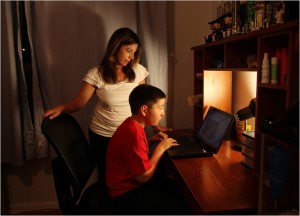 Guess you'll have to lie about your age by Rosemina Nazarali
KiwiCommons.com
Kiwi Commons is a late-breaking news, guides and information weblog dedicated to providing readers with the most relevant and up-to-date resources available on youth Internet safety. Kiwi provides readers with a broad range of thoughts and opinions from various experts, including their own Kiwi Expert Panel, to real life stories of the youth affected by these new challenges like sexting, scams, cyberbullying and predators.
It comes as no surprise that a good portion of Facebook users lie about their ages. It does come as a surprise, however, that almost half of all 12-year-olds in the U.S. use social networking websites, despite the site requiring a minimum age of 13.
With no mechanisms in place to detect when a person is lying about their age, there’s no telling who or how many under-agers are actually using Facebook. However, Facebook has taken notice and is kicking out about 20,000 users each day, many of whom are among the 12 and under crowd.
“Facebook uses various methods to identify underage accounts, including the monitoring of information placed on the site and community reports from other users,” said Facebook’s Chief Privacy Advisor, Mozelle Thompson.
With this, however, comes an array of new questions, this time for the parents. Would you let your child lie about their age to sign-up for a social network? This is the hypothetical question that has been burning up the Internet since last week, and many of the differing answers are quite surprising.
“Not only are kids lying about their age, but more often than not, parents teach them to lie about their age,” said Danah Boyd, a social media researcher for Microsoft.
So I became curious. I wanted to know what parents on the Internet were saying about the matter, and what the justification was for either allowing or not allowing their kids to sign-up for Facebook.
Crisntina Flores, a 44-year-old mother to an 11-year-old boy said she did allow him to sign-up for Facebook because she feared he would sign-up behind her back anyway. Her son, Jake, told Facebook he is 15. “It’s not like there’s a legal limit for being on the Internet,” Flores said.
15 of 30 students in one of Jake’s fifth-grade classes are all on Facebook. “It’s lying — and about age,” said the class’s teacher, Aundrea Kaune. “What happens when they want to drink beer?”
“Allowing kids to lie by creating a profile with a false age…is a different issue than allowing activity online that, frankly isn’t even appropriate offline,” one parent, Cameron Sullivan, told the DublinPatch. “Some of my contacts on Facebook have middle-school kids whose pages are open to friends of friends. I don’t have time to waste monitoring other kids’ lives online, but on the rare occasions that I venture to their kids’ pages, I am grateful for the parents’ ignorance. The ability to see what kids are posting online provides a window into the goings-on of some middle-school kids.”
Another parent, Kari Kulac, who let her fourth-grade daughter sign-up for Facebook is starting to question her decision. “It’s only been a couple of months, but I’m unsure whether I should let her continue, not because of safety fears but because it is yet another time suck that has to be monitored along with all the other frivolous electronic pastimes (TV, etc.). I’d rather she be running around outside,” Kulac said. “The benefits, I suppose, are the social enjoyment she has getting to better know my out-of-state side of the family, including my 87-year-old grandmother.”
But it’s not just Facebook kids are fibbing on. Victoria Lai, a ninth-grade student in San Francisco, said she signed up for Yahoo! Games when she was just in the second-grade. “I always say I was born in 1986, not 1996, because it’s just one number different. Easy to remember.”
Victoria’s father, Brian Lai, says that kids “have to experience using the Internet. It’s the future.” He added, “it’s not good to lie, but you can make an exception.”
May Jay Hoal of Yoursphere brings up a point. “Parents can’t forget that Facebook was created by adults and for adults, and the adult culture that lives on Facebook is usually one that we likely wouldn’t expose our children to in the ‘real world.’”
One thing many of these Facebook users who aren’t quite honest about their age don’t realize, is that once you’ve signed up with a certain birth date on Facebook, it cannot be changed. So unless you plan on opening a new account after you hit the age of 13, you’ll be stuck appearing as the wrong age you originally input for a very long time.
After reading what all the parents had to say, I went to Kiwi Commons expert, Doreen Nicastro, to find out how she felt about young people using Facebook before they were ready.
“From both a developmental and safety standpoint, no kids under the age of 13 should have a Facebook account, period end of story,” she said. “Parents are being manipulated and bullied by their own kids to get access to social networking. The fact of the matter, it’s against Facebook terms of agreement for kids under the age of 13!”
Nicastro suggests that the adults start communicating with each other. “Parents, schools and law enforcement in communities across the world need to come together and discuss the rules of the social networking road. New tools require new rules. The problem is that schools are shutting it down, parents are too busy and stressed to get engaged, and kids are running the show.”
While parents and young people continue the ongoing argument surrounding social media use, Facebook is looking for a solution for their under-age users. They are currently considering creating a safe social network for the 12 and under population — a place meant just for kids and a way to dissuade them for signing up for Facebook before the required age.
We want to know — would you let your kids lie about their age to engage on social networking websites like Facebook?

July 22, 2011
 Almost ready for my close-up Tuesday morning was not typical. Before 8 o’clock I had my professional act in gear (make-up, hair, couture… such as it is) and took my show on the road. Twenty miles south, David and I pulled up to FoxNews.com’s San Francisco studio and into a parking spot six steps from the front door.
I’d been invited to Fox (no relation) to offer my expert opinion about the choice of some parents to permit their teens to have sex in the family home. What did I think about this trend? Truthfully, I hadn’t heard about it. But I take these assignments seriously so I did my research. Rule of thumb: If you’re going to put yourself out there as someone who knows what she’s talking about, it’s best to try to sound like you know what you’re talking about.
Here’s a 6 min clip of my interview with Jonathan Hunt, a thoughtful interviewer with good questions, a good sense of humor, and good listening skills.

In case you’d rather read than watch the video (though you can do both for the same ridiculously low price… free) here’s the big take-away:
Parents are hard-wired to keep their kids safe. Any hint of a threat to the young ‘un and our inner Mama or Papa Lion instantly reacts. No thinking involved, which is kinda perfect since over-analyzing in an emergency can get in the way of surviving. But not everything parents perceive of as threatening is actually a threat and an over-the-top reaction can be counter-productive. (Like when you encourage your teen to come to you with any questions and when they ask about sex or drugs, you totally freak out thus shutting down all conversation and insuring (s)he won’t be coming back to you with important stuff any time soon.)
Thankfully our brain also specializes in rational thought. The long-term, rational approach to parenting says our #1 objective is to raise a fully functioning independent young adult. That’s why we’ve got to teach our kids to analyze situations. And to make healthy choices. That’s the only way they can keep themselves safe when we’re not around, which is going to account for most of their lives unless you’re planning on having them live with you forever, in which case we need to talk.
Mr. Hunt quoted this statistic: “By their 19th birthday 70% of young people have had sexual intercourse.”
Translation: They’re going to do it anyway, so why not let them do it in the family home rather than a car or in the park, since it’s safer? Or do you think that’s just off-the wall?
There are enough Parent Police out there judging the way other folks raise their kids and I’m not going to join the squad. How you, as a parent, educate your children about sex is a personal decision. But, the reality is; older teens will be doing it.
Wherever you stand on this issue, here’s my advice (again free for the taking):
- Talk about relationships rather than just the “yes” or “no” of teen sex. Talk about sex in context of a relationship, rather than hooking up. If you don’t know where you stand on teen sex or you’re conflicted, that’s honest. Tell your teens that. But remember that you have a leadership role. If you want to transmit your thoughtful values to your teen (as opposed to “Just say no.”) then spend some time thinking about what those values are and why you hold them.
- It’s not just one talk. Have a series of conversations. Treat teens with respect. Talk less and listen more. That’s the only way you can find out where they are coming from, what assumptions they have about relationships, etc. There are endless opportunities to have conversations while you’re watching TV, after a movie, reading the news, listening to song lyrics, etc. It’s very important that the parent’s voice is in a teen’s head. You’re not going to be the only voice in there, but you want to be part of the mix and parental influence is powerful.
- Be realistic. Sex is part of life for adults and for older teens. In the context of a healthy relationship (the only kind worth having) it’s a joy. Parents who are in denial about teens and sex remain silent and their teens remain uninformed. Some people believe that talking to teens about sex encourages them to become sexually active… right now! Just the opposite is true. Studies show that teens whose parents provide them with reliable information actually wait longer to have sex and are more likely to use protection when they do have sex.
At some point, your teen will decide that (s)he’s ready to have sex. You want the decision to be made from a basis of self-knowledge and information coupled with values. You also want that information and those values to come from you. If you don’t talk to your teens about sex and healthy relationships (mutual trust, respect, etc.), where do you imagine they’ll get their information and values from? Probably from their clueless friends. Not a comforting thought.
July 17, 2011
Just got an unusual email from a woman who thinks her daughter has a problem. Have a read and see what you think…
Dear Annie,
My daughter and I are not seeing eye to eye. I want to help her with but she will not listen to me. You always hear of parents not wanting their kids to go with the crowd. But my kid does the opposite. She dresses like a boy, only wearing boy’s sports shorts and a t-shirt. She doesn’t like anything girly. Absolutely nothing!! She isn’t boy crazy, that’s a good thing. It is beyond being a tomboy. During sports she will never put her hair up or back like the rest of the girls (even though the coach tells her to). Even on group pictures of the teams she is the only one with her hair down. Could it be that she wants to stand out or that she is trying to fight the establishment? I want her to be herself but this has gotten way overboard and it is causing a lack of friendship. She almost has no friends because she is so different. Should I just let her learn the hard way?
Frustrated Mom
Dear Mom,
I’m not sure what you think your daughter needs to “learn the hard way” or any way for that matter. And while we’re clearing stuff up, how can anyone possibly go “overboard” in being themselves? That’s like saying, “You are too much of who you are.”
You say “I want her to be herself”… but do you really? What I’m hearing loud and clear sounds like “The way she is, is unacceptable!” If that’s where you’re coming from your daughter feels the sting of your disapproval every day. That’s not helpful.
The only positive thing you said about your daughter is that she’s “not boy crazy.” Surely she possesses many admirable traits, but you didn’t mention any. That’s a sign this girl isn’t getting much positive feedback from her mom. Also not helpful.
Clearly you believe your daughter has a problem and if she’d only “listen” to you all would be well. I disagree. This isn’t about you or your well-intended advice. Your daughter may be rejecting girly clothes because she’s questioning her sexual identity. If that’s the case, she’s not purposely defying anyone, rather she’s on an important journey of self-discovery. Whatever her sexual orientation is, she doesn’t need “fixing.” With all due respect, you may be the one who needs a course correction, not your daughter. Because it sounds like she’s doing her own thing very well, thank you and I say, props to her for all that self-confidence!
I don’t mean to give you a hard time. I’m a parent. I understand what it’s like to have expectations of your daughter from Day #1. All parents dream of what their child will grow up to be. Maybe your daughter’s behavior, choice of clothing, etc. is a disappointment to you. Be honest with yourself about that disappointment. Maybe her way of being is embarrassing to you as you watch the reactions she gets from peers and other adults. Please be honest with yourself about that embarrassment as well, but don’t share these emotions with your daughter. She doesn’t need to hear it.
Bottom line, your daughter is who she is and trying to get your approval by pretending to be someone other than her authentic self is not healthy. That would only encourage her to live a lie and put her in conflict with herself. Not the advice she needs.
I’m going to state the obvious because it’s a good reminder to all parents. Your child is not you. And it’s not her job to fulfill your expectations of who she’s “supposed” to be. She is her own wonderfully unique self. She doesn’t need fixing. She needs the unconditional love of her mom. In order to support her journey into adulthood, wherever it may lead, you need to stop trying to change her and start trying to understand her better. I’d strongly suggest you talk with a family therapist or a psychologist ASAP. Hopefully that will help you sort out your feelings so you can learn to accept your daughter and give her the support she needs.
I hope this helps.
In friendship,
Annie
July 12, 2011
by Roberto Lebrón
Summer may seem like an odd time to discuss homework, but I can’t think of a better opportunity to appreciate the absence of it. Isn’t that part of the reason families cherish July and August? Because without homework we all have more time to hang out and be a family. Today’s guest blogger is Roberto Lebrón, teacher, artist, writer and founder of the blog Raising Children on Planet Earth, where you can find “… values and behavior tips and information for brave, loving parents who are willing to do the hard work of raising their own children, instead of delegating their duties to others, including the government, or letting their children raise themselves. You’ll also find food for thought for peaceful, mindful, no-drama dadas and mamas.” AF
 I hate homework! I hate homework.
That may sound strange coming from a teacher. At work, I’ve often heard parents asking teachers for more homework for their children. I’ve also heard parents brag to each other about how good the schools their kids attend are, using the amount of homework their kids get as a measure.
Considering these parents hated homework as students about the same as their own children hate it now, one can wonder why they are so eager to foist upon their children the burdens they resented in their youth. Is this you? Why do you do it?
Perhaps it’s wisdom.
Perhaps parents have learned that what they resented as children was actually good for them — like vegetables. Is this true? Is homework the broccoli of the school world?
Alas, I think not.
The sad truth about homework is that it’s useless makework and, as far as I’m concerned, an unwelcome intrusion into family life. But let me define my terms.
What I Don’t Mean:
When I say, “homework,” this is what I don’t mean:
- I don’t mean reading material that will be discussed in class, or material on which the students will be tested. That’s called studying.
- I don’t mean projects to be developed using knowledge acquired in class and research done out of class.
- I don’t mean the aforementioned research.
What I Do Mean:
- I mean the other stuff parents love so much because it keeps children busy and out of their hair while they’re at home.
- I mean that other stuff because when my children are at home, I’d prefer them to enjoy a little something I like to call home life.
If this homework is so important from an academic point of view, I’d just as soon have it done at school, even if that means longer school days. As a matter of fact, I’m all for longer school days, and a longer school year, with shorter vacations. I bet you’re not surprised to hear that coming from a teacher.
Yes, the fact is that, as educators know, and as the President of the United States has acknowledged, we need a longer school year, because we are falling behind other industrialized countries in terms of education. Many of those countries have longer school days and longer school years than we do.
Why Our Calendar Is The Way It Is.
Our school year was designed the way it is in part to allow young people time to work with their families when ours was an economy largely based on agriculture. That reason has gone with the wind. In the meantime, studies have shown that students forget too much of what they’ve learned during the school year during our excessively long summer vacations.
The summer camp industry knows this and many summer camps use this fact to encourage people to enroll their kids in programs that have academic components. This is a poor solution to our problem. Local school boards, not private camps, should determine what our students learn during the summer, and how they learn it. This is our responsibility as a society, and we are neglecting it.
In the end, it may not be necessary to have much less total vacation time during the year. Extending the school day and modifying the length and number of vacations during the year may do the trick. What is clear is that we need to modify our school calendar, and that most homework is a waste of everybody’s time.
Take Action!
1. Get Your Money’s Worth.
- Your schools are yours. You’re paying for them, whether directly with checks to private schools or indirectly through your taxes. That gives you a voice. Use it.
2. Speak to Parents and Teachers.
- Speak with other parents. Speak with your children’s teachers.
- Let them know you value family time in your home, and you don’t appreciate losing this precious time to makework homework.
- Make a clear distinction between learning to do research or studying for tests, on the one hand, and pointless busywork, on the other.
- Discuss the need to change our school calendar to keep up with competition in the global marketplace.
- Parents and teachers should work together as partners. Let your partners know you’re an active participant, and you expect your concerns to be taken seriously.
3. Contact Your School Board.
- In most places, School Board members are elected officials. Reach out to them and let them know your concerns.
- Let them know you have seen past the myth of homework. You know that overwhelming children with makework homework is not a sign of a good education.
- Emphasize the need for family time at home free of useless busywork.
- Call for a modification of our school calendar to catch up with other countries.
- Don’t get discouraged when your first efforts are dismissed. Moving bureaucracies to change is difficult, but not impossible. Pace yourself, and don’t give up.
- The above goes for your state’s Department of Education, too.
4. Use Your Tools.
- Share this article on Facebook. Tweet it. Stumble it. Spread the word.
You are not alone in feeling that our children need to be unburdened from most if not all of their take-home busywork. They deserve more family time today and a better chance at success tomorrow. You can help make “Less Homework” a reality in schools everywhere. Do it.
— Older Posts »
| |



















 Facebook
 Twitter
