|
|
June 28, 2011
Because I write for kids about social and emotional learning I spend a fair amount of time in schools presenting to students, teachers and parents. My perception of any school is only a snapshot, but it’s often revealing and well… educational.
Over the years I’ve had the privilege of meeting and observing many many wonderful administrators, counselors and teachers. These men and women are highly effective educators and leaders, as well as compassionate human beings and beloved mentors. Each is a special gift to their students but it’s a gift all students deserve.
In my travels I’ve also encountered those who seriously have no business working with kids. A middle school coach who screams like a Marine drill sergeant. A teacher who sarcastically greets a specialist with: “Thank god you’re here. JOEY! GO!! Take him!” A school secretary who viciously brow-beats a timid group of late-arriving students.
Once, during a professional training I led (for which all teachers were paid to attend) one teacher continuously texted, one slept, and another graded papers never once looking up or participating in a lively discussion on how to encourage students to be more respectful in class.
When I encounter folks like these I wonder, Why are these people permitted to teach? Everyone knows who the “bad” teachers in any school are and yet year after year their principals agree to let them continue damaging children. Why?! How do the bad teacher’s students and their parents feel about the sentence they’re serving in that class? What, if any, are their rights? How does having a bad teacher as a colleague makes the good teachers at the school feel?
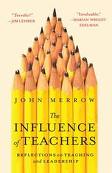 A book that can change American public education John Merrow, author of The Influence of Teachers: Reflections on Teaching and Leadership, has also wondered and researched and documented these issues and others. The result is the best book about education I’ve ever read. Merrow has been covering the field for NPR and PBS since 1974 and is currently Education Correspondent for PBS NewsHour and President of Learning Matters, Inc., an independent production company in New York City.
I love books that make me think in new ways. I especially appreciate those that shine a well-informed light on the political and social dynamics of institutions that affect children. Merrow knows the situation in American public schools. He’s taken the time to interview district-wide stake-holders in many communities. He finds too many public and charter schools damaging the kids they ought to be committed to serve. In light of the ongoing national conversation on school reform, this isn’t a surprise. What is surprising is how directly Merrow defines the problem and calls out those most responsible for perpetuating a broken system. The way he sees it, leadership is key and that key has been missing for too long at the district, school and classroom levels.
If you’re lucky enough to be satisfied with your kids’ schools you might think, “Yeah, that’s a shame, but it’s not my problem.” Of course it is. Kids coming out of under-functioning schools are heading toward an adulthood with few bright options and many frustrations. Cheated by their schools, they’re turned out into society under-educated and lacking the ability to think critically. With what they’ve been given, they can’t succeed. In a nation that claims “Our children are our greatest resource” that is nothing short of criminal.
I urge you to read The Influence of Teachers. Encourage parents, teachers, administrators, superintendents to do the same. Come armed with it to the fall’s first PTO meeting. Get real about what’s broken in your school. Use John Merrow’s strong recommendations and work together. We’ve got to do this for our kids. If not, they can rightly assume we don’t care all that much about them or the country’s future.
UPDATE: Exciting news! A new teacher training bill was introduced in the Senate on Wednesday. It’s called Crowing Excellent Achievement Training Academies for Teachers and Principals. Read more.

June 17, 2011
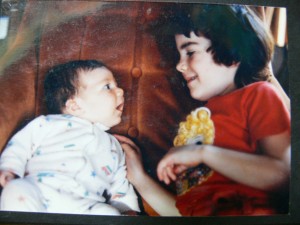 Maybe he's not so bad after all. Got email from a young dad who recently had a second baby. He and his wife were surprised at their 5 year old daughter’s reaction. “Emma clearly doesn’t like receiving less attention and has shown a change in behavior since the baby arrived. Thankfully she hasn’t taken it out on him, just directed it towards us.”
It was only 6 AM but Big Sister’s reaction was so familiar I skipped my starter cup of Earl Grey and immediately replied:
Hey Worried Dad,
If not classy, your daughter’s reaction is classic. During our son’s first 6 months, our daughter (also 5 at the time) was no ray of sunshine. Like your Emma, our girl never directed her resentment toward her brother, but she was obviously pissed at us… specifically me. Stands to reason. Five years she’s a mega star. Parents, grandparents, hell, even the UPS guys light up when they see her. She starts walking, talking and drawing pictures… OMG! Accolades pour in! That’s her life until… one day, Mom & Dad bring home a little blob in a blue blanket and bingo, Glory Days are gone.
From Child #1’s point of view, the arrival of #2 is the equivalent of Husband telling Wife, “Sweetie, I’d like to introduce you to my second wife. Isn’t she beautiful? And guess what? She’s going to live with us… FOREVER. I still love you, but you won’t be getting as much attention. We won’t be doing as much fun stuff together either. You see, my second wife has lots of needs so I’ll be focusing on her. When I’m with her, don’t interrupt us. If you do, I’ll probably get annoyed. I may even yell. Be quiet while she’s sleeping. And don’t bother me while I’m resting. Even though it looks like the coast is clear and I may be ready to spend time with you, I don’t have extra energy because it’s all going to… you guessed it, my second wife.
“What’s that? You’re not happy with these changes? You wanna know what you’re going to do about all this? I dunno. That’s your problem. Oh, one more thing… You must love my new wife as much as I do and share everything you’ve got with her. And don’t forget to smile. That’s very important. I want her to feel welcome.”
How would you feel if your one-and-only laid that on you?? OK, I see you’re starting to realize that Emma’s got a legitimate beef. Look, incorporating a new baby into the family isn’t an easy transition for any of you. Here are some suggestions that might help:
1) Acknowledge to Emma that her feelings of jealousy, resentment, etc. are TOTALLY VALID. Don’t make her feel like she’s “bad” if she’s not thrilled with the baby. While it’s OK for her to feel whatever’s she’s feeling, obviously it’s not OK for her to act out. Let her know that you guys get where she’s coming from then provide her with opportunities to express her feelings in responsible, appropriate and safe ways.
2) Dad, create special one-on-one time with your daughter. You and she deserve a weekly “date” outside the house, just the two of you. It will do wonders for your relationship and her behavior. Same with Mom and Emma. Insist they go off together once a week (at least for an hour or two) while you bond with your new son and give Mom a break.
3) Give Emma special “big sister” responsibilities. (No cleaning up or other yucky duties. Only the fun stuff!) Have her read to the baby. Sing to him. Draw pictures for his wall and let her explain the art to him. Show him how to play with his toys. Tell your daughter that her brother wants to get to know her. He’s curious about and impressed with all the things his Big Sister can do. He needs her to show him so much. Give her the opportunity to be one of his teachers and they will learn to love and appreciate each other.
It sure turned out that way with our little girl and her baby brother.
June 15, 2011
by Lisa Elifritz
One year ago this week, Lisa Elifritz lost her daughter, Amy Rae Elifritz, to Toxic Shock Syndrome. a rare but serious bacterial infection. In Amy’s memory, Lisa founded You ARE Loved, a non-profit organization committed to raising awareness about TSS. According to Larissa Hirsch, MD, TSS is a “very rare illness. Although it can be fatal, if recognized and treated promptly it is usually curable.” Thank you, Lisa, for doing your part in the areas of TSS awareness and prevention. Your beautiful daughter would be so proud of the work you’re doing.
 In loving memory of Amy Rae Elifritz (1989-2010) When my twenty year old daughter was hospitalized with flu-like symptoms, no one suspected Toxic Shock Syndrome (TSS), even though Amy was menstruating and had been using tampons. Unfortunately, she lost her life to TSS a few days later. In her memory, please take a few minutes to learn about Toxic Shock Syndrome and to share this information with your daughter, granddaughter or any t(w)een girl you love.
Symptoms of TSS
Only one or two symptoms may occur. They do not necessarily occur all at once and may not persist.
• Sore throat.
• Aching muscles
• High temperature (over 102F)
• Vomiting
• Headache
• Watery diarrhea
• Red rash
• Confusion
• Dizziness
• Very low blood pressure
What You Should Do
Quick action can save a life.
• Remove the tampon (save it if possible)
• Seek IMMEDIATE medical attention
• Inform the doctor that you have been using tampons
To Reduce the Risk of TSS
• Use the lowest tampon absorbency needed at each stage of your period and change tampons often
• Avoid using tampons continuously (alternate with sanitary pads, particularly at night)
• Use a pad or pantyliner at the end of your period instead of tampons
• Wash your hands before and after use (also handle the tampon as little as possible)
• Alert your family and friends to the symptoms and emergency action required
• Consider using other internal feminine hygiene options that don’t have the same risk of TSS (menstrual cups or tampons made of organic cotton)
According to the Center for Disease Control “In the United States, annual incidence of TSS is 1 to 2 women out of 100,000 women 15-44 years of age (last active surveillance done in 1987).”
TSS is a medical emergency. Part of prevention is communication. Young girls must discuss with their parent when they decide to use tampons. Someone else should know when tampons are used so that prompt action can be taken if the sufferer is unable to help herself.
If you or a young woman you know has been using tampons and/or intravaginal contraceptive devices (such as diaphragm and sponge) and experience flu-like symptoms and a fever, remove the tampon and go to the hospital immediately. Insist on getting blood work. If it is caught early enough and treated correctly, TSS is usually curable.
June 9, 2011
by Miranda Paul
Miranda Paul teaches both English and Spanish in Green Bay, Wisconsin. She holds a BA in English and Education from St. Mary’s College of Maryland where she helped launch a student-teacher exchange program in Gambia, West Africa. In her spare time, Miranda is a freelance writer for the University of Southern California’s Masters in Teaching online degree program.
When I began student teaching eight years ago, I didn’t belong to any social media sites. But in less than a year I learned an important lesson: Social media saves students. That first year I had one particularly challenging class among my 9th and 11th graders. The class was difficult because many students were too shy or intimidated to share their opinions. I did my best to encourage them, offering prizes for speaking up, etc., but by the end of my student teaching, only a handful of the most outgoing students had expressed how much they enjoyed my unit on poetry.
I felt I really hadn’t reached all of my students and that I had failed. Then one day, the following summer, I opened a heartfelt three-page email from a former student who rarely spoke in class. She described how, during the school year she had contemplated suicide, but poetry helped her through tough times. She was grateful for a handout I’d given in class, listing poetry forums where kids could post their words online. On those social media sites, she found friends and the confidence to discuss many issues. Her last line summed it up: Poetry saved her life and I had introduced her to poetry. That was powerful. A student who seemed afraid to talk in class wasn’t scared of publishing her words for all to see. Social media had saved a student’s life.
When I landed my first teaching position, I tried to include every technology available to me that would help me reach all of my students academically and developmentally. Student work was scanned and written about on blogs. Both parents and students had my e-mail address on the first day of school. By the next year, I had several students writing their own blogs. Several parents were skeptical – but others were enthusiastic about their child’s increased participation.
Social media is the new language of kids. If we want to reach them, we need to speak their language. But it’s equally important to make ourselves available on their platform so that they are able to reach us. Last week, I spoke to a group of 7th and 8th grade girls about some charity work I do in a small African country. After the presentation, the girls were eager to help with the project. “Are you on Twitter?” one girl asked, pulling out a phone, ready to type. The school day was technically over and parents were ready to leave, but the girls wanted to continue learning and social media would help them do it. I directed her to Facebook (I’m not yet on the Twitter bandwagon…). Because they had a way to reach me, within a few days, my charity more than doubled its Facebook fans.
I’m not the only teacher, student or parent who believes in the power of social media to connect and empower us all. Recent articles in The New York Times provide more convincing evidence of the growing educational and emotional power of social media. I loved reading about how Iowa English teacher Erin Olson used technology like Twitter to increase classroom discussion participation by more than 25%. In another story, retired history teacher Bill Chemerka discovered his impact on students when he found a Facebook fan page called the “Mr. Chemerka Fan Club,” with more than 450 members. Alye Pollack’s YouTube video is yet another example of how social media was the only way Alye felt confident enough to speak up about the issue of being bullied.
Based on my experiences and that of others, I’ll keep social media in mind as I prepare to teach summer courses (I’ve actually requested to teach one of my courses in a computer lab). Of course, as the traditional English teacher I am, I’ll also be bringing plenty of pencils and paper.
— Older Posts »
| |


















 Facebook
 Twitter
