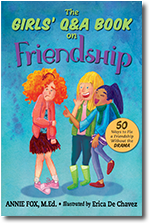
After a brief hiatus (due to an Autism Awareness Month blog and a review of the new documentary Bully), here is Part 4 of a 5-part series on elementary school friendship issues. If you’re new to this series and you want to help the kids in your life deal with peer conflicts and bullying, please check out the previous segments: Friendship issues from the 2nd grade, the 3rd grade, and the 4th grade) For those of you with kids or students in 5th-8th grade, you might want to check out my Middle School Confidential™ book and apps series. It’s all about helping kids value themselves and learning the difference between Real Friends and the Other Kind. If you love a 4-8 year old, check out my picture book: Are You My Friend?
Now to the 5th graders questions:
How do you know someone is your friend? + 7 other similarly worded questions.
It’s a great question because you can’t tell just from looking at someone or maybe not even from knowing them for a little while. So how can you tell when someone is a real friend or a fake friend? To answer this question, I asked my best friend, my husband David. Without hesitation he said, “By the way the person treats you!” Excellent answer! I agree. If you are wondering whether your friend is the real kind, there’s probably something going on that makes you uncertain about the friendship. Otherwise, you wouldn’t be asking the question. Aside from looking at your friend’s behavior, there’s another piece to figuring out if someone is a true friend or not, and that has to do with the way you feel when you’re with that friend. If you feel relaxed, safe, respected, accepted, listened to and comfortable enough to “be yourself,” then chances s/he is a real friend. Make sure that you are a real friend too!
If your friend is telling secrets, what should you do? There is no rule that says friends must tell each other everything. People are allowed to keep things to themselves if they choose to. But I get the sense from your question that you feel your friend is talking about you, behind your back, in unkind ways. If you know this for sure then you should talk to your friend about it. Choose a private place (you don’t need an audience) and tell your friend what you’ve heard and how it makes you feel. Get to the bottom of what’s going on. That’s what friends do.
A girl bullies me all the time. She just got glasses and people are making fun of her. Should I stick up for her? You’ve got a good heart and you know how it feels to be teased and bullied. It makes you uncomfortable watching it happen to other people. You know that standing up for her is the right thing to do. It’s also the right thing to stand up for yourself the very next time she bullies you. Who knows? This may be the beginning of a great new friendship!
If a really cool person is really nice to you, but mean to other people, should you be their friend or not? It sounds like you may be a bit confused about what it means to be “really cool”. Truly “cool” people are not mean… to anyone! I can tell that you are “cool” because you have noticed this mean behavior and it obviously bothers you. When we notice things like this and we feel uncomfortable, it’s time to ask “What am I going to do about this?” I understand that the mean behavior isn’t directed at you, but let that uncomfortable feeling guide you in the direction of doing the right thing. The right thing to do, the “really cool” thing to do, is to stand up for the people who are being treated badly.
Why do other people feel like they have to bully people?? Such a great question to think about! There is no one “correct” answer, but sometimes, when we feel hurt, or jealous, we can get so angry we feel like hurting someone. When most of us feel that angry, we try to control ourselves, calm down and think things through. If we need to talk to someone about what just happened, then we can do that. Choosing to talk instead of retaliate (attack back), takes maturity. Sometimes it’s a challenge to have that level of self-control and maturity. Sometimes we might not even be aware that we are bullying other people. That’s why it’s so very important, whenever someone is disrespectful to you or anyone else, to speak up. That’s the first step in reducing the amount of bullying in schools.
If a person you’ve known for a really long time (and was your only friend for a while) now starts acting like you can’t have any other friends and is being mean, what should you do? Your friend’s “meanness” may be coming from the fact that s/he is afraid of losing you. Your friend cares about you and wants to spend all their time with you, but the mean behavior is pushing you away. Exactly the opposite of what your friend wants! You need to talk with your friend ASAP. Because you two have known each other for such a long time, hopefully you can be honest with each other. Tell your friend that the meanness is not OK and reassure your friend that just because you want to spend time every now and then with other friends, doesn’t mean you don’t care about the friendship. You do!
A new kid from another country is being bullied because she can’t speak English. If you don’t even know her, should you stick up for her? I think you already know the answer to this question. The answer is YES! This girl needs a friend badly. Someone who can help her feel comfortable at school. Think about what a HUGE change it must be to leave home and travel to another country, to a new school where she knows no one, and is now surrounded by people speaking a language she doesn’t understand. That takes a lot of courage and a lot of getting used to. Please do whatever you can to be kind to this girl. Not only will you be helping her and showing her how friendly and welcoming American students can be, you will gain a new friend and learn wonderful new things about her culture.
What if someone is mad and ignoring you for something you didn’t do? It sounds like there was a misunderstanding that needs clearing up. That can only happen when you two talk to each other. I understand that right now this person is “ignoring” you and you can’t have a conversation with someone who isn’t talking! I suggest you write this person a note. You might say something like this, “I know you are mad at me, but there’s been a mistake. I would like to talk to you. How about during lunch?” Then find the person at lunch time and talk about it calmly and respectfully. Hopefully, this person will listen to what you have to say and in return, you will get to hear their side of the story. (There are always at least two sides to every story.)
Friend A is having a party. She invited everyone except Friend B. Friend B found out and she is mad at me for wanting to go. Will she ever be my friend again? Should I go? I need to go so I can be popular. Is it worth it? Of course you have the right to go to the party. But you can probably understand why Friend B is upset that a) she didn’t get invited and b) you did and c) you want to go without her! Going to the party may not be a big deal in terms of your friendship with Friend B. There is a chance that after the party, the friendship is as strong as ever. But on the other hand, what you say about “I need to go to the part so I can be popular.” makes me wonder if the Popularity Game is more important to you than your friendship with Friend B. That’s something you may want to think about. People who dump friends because they aren’t “popular enough” often find themselves without real friends.
If you’re shy, how do you make new friends? Everyone is shy is certain situations, but I want you to know that you’ve already got what it takes to make friends. Instead of thinking of yourself as “shy” maybe it would be more helpful to say to yourself “I’m a great kid. I like people. And when I give people a chance to get to know me, they like me too.” To give yourself more opportunities to meet new people this summer, you might want to get involved in some activities you enjoy. Right from the first day, you’ve got at least one thing in common with every other person in the group. So think about what you enjoy doing (sports, art, music, photography, animation, computers, hiking, nature, science, etc.) and find out what opportunities your school or community offers for kids your age. Good luck!
If your friend starts bullying you and also lying, how can your tell them nicely that you do not want to be their friend anymore because they were mean and bullied you? You tell your friend you want to talk. You find a private place where you can have a conversation without being spied on or interrupted. Then you take some slow deep breaths to calm yourself. When you are calm, you respectfully say this, “The way you have been treating me is not the way a real friend acts. I’m taking a vacation from this friendship.” That’s it. If your friend has something to say then be respectful and listen. You might hear an apology. You might hear excuses. You might even hear “I don’t know what you’re talking about!” Bottom line, you know how it has felt to be in this friendship recently. If you want “out”… then that is your right. You should never put up with disrespectful treatment from a friend or anyone else.
If your BFF tells you to do something you don’t think is right and if you don’t do it your BFF won’t be friends with you, is she worth it? Should I do it? Should I just let her go? Anyone who pressures you to do something that you know isn’t right, is not a real friend. Real friends respect your values. Real friends do not threaten you to get their own way. You already know that going against what’s right is not “worth it.” Tell your friend where you stand and see what happens. You may actually convince her that what she’s considering isn’t right for her either. In that way, you might be turning her negative peer pressure into positive peer pressure! That would be a good thing for a friend to do!
How can you tell when someone wants to be your friend and then doesn’t want to be your friend any more? and this one What if your friends with someone but they keep doing mean things to you but at other times there nice. Should we still be friends or not?
A real friend respects, accepts and appreciates you. Friendship should be based on mutual (2-way) respect, honesty, trust, open-communication and shared values. That doesn’t change. Real friendship isn’t like a water faucet that can be turned on and off. If the person you’re talking about changes their mind about wanting to be your friend or changes the way they treat you, it may be hard to trust that person and to count on them. And without trust, friendship can not going to grow in a healthy direction.
What can you do if you had 2 groups and they didn’t get along? and this one If you had 2 groups o friends that you thought wouldn’t come together well, how would you merge your 2 groups together. It would be nice if everyone got along but you can’t make that happen by yourself. Putting yourself in the middle with the feeling that it is your job to make these 2 groups get along is just going to stress you out. It isn’t your job to make everyone happy. Not every separate group has to be “merged” into one group. The simplest solution is to spend some of your time with Group A and some other time with Group B.
If you have friends over and you don’t invite someone and they find out what do you do? That’s an awkward situation. There is no easy answer here. It sounds like you might not feel as close to the person you didn’t invite as you do to your other friends. That’s OK. That’s normal. We don’t feel equally close to everyone we know. But coming right out and saying that is unkind. When the person who wasn’t invited asked you why, all you can do is apologize and say “I’m sorry you were disappointed.” That’s the truth. I know some people might encourage you to make up a convenient excuse like “I could only invite 4 people and you were #5.” But I wouldn’t suggest that because this situation is probably going to come up again and you’ll have to keep inventing fake excuses. No fun! In life, we choose our friends and sometimes other people get left out because we don’t consider them to be close friends. Sometimes you are the one not inviting and sometimes you are the one who doesn’t get invited. It’s not always ‘fair’, but that’s the way it is. Hopefully, we can each find our own group of friends who wants to invite us places. Those are our real friends.
What if you want to be friends with a person but every time you try to be their friend they do something to make you not want to? Why would you continue trying to be friends with someone who clearly doesn’t treat you with the respect you deserve? My advice, stop knocking on that door. You deserve better treatment than that! And can get it because there are plenty of other people who know how to be a good friend. Knock on those doors instead.
What do you do if your friend does something wrong, but you’re afraid your friend will get mad if you tell on him/her? If what your friend did is hurtful to other people or dangerous to himself, then it’s important for you to talk to an adult. Why? Because it sounds like your friend needs to learn that this isn’t OK. When the message comes from an adult, often kids pay more attention than if another kid tells them. And if you tell, you’re right, your friend might get mad at you… but if you stay silent when someone does something wrong, then you are allowing it to continue when you could have done something to stop it. Do the right thing!


















 Facebook
 Twitter
