

Annie Fox's Blog...

Thoughts about teens, tweens, parenting and this adventure of living on Earth in the 21st century.

Annie Fox, M.Ed., is an internationally respected parenting expert, award-winning author, and a trusted online adviser for tweens and teens.

Raising kids who are at home with themselves

January 15, 2010

Life isn't always a bowl of cherries.

Life isn't always a bowl of cherries.

When I was 15 my father died suddenly. Though I continued living at the same address until I left for college, it never again felt like home. That’s probably when I began looking for something that couldn’t be lost or taken away – a feeling of home inside myself.

When you meet someone who is truly at home with herself, she put others at ease by osmosis. Her self-acceptance expands to include accepting you. We are instinctively drawn to such people.

Many of your children will be graduating this spring… from elementary school. From middle or high school. From college. Big changes in store that are best weathered by kids who are at home with themselves so they can be “at home” wherever they are. Accepting of others and new situations.

How well prepared are your children for the next chapter in their lives, whatever it might be? How confident are they in their ability to cope with and adapt to what’s ahead? And what can you do to help and support them throughout? Here are some tips:

How to raise young adults who are at home with themselves

1. Create a home base that’s a safety net and a launching pad. Home should support a child’s emotional development and nurture his spirit. With a stable, loving and accepting family to return to anything is possible… even venturing into the unknown. Kids who grow up with a strong foundation are like turtles, always carrying their sense of home along with them. Remind yourself often that your parenting goal is to prepare your children for life. That means helping them develop critical thinking skills. It also means acting with compassion, kindness, and generosity of spirit. Whenever you catch your teens doing or saying something that demonstrates these capacities, let them know you approve. It helps them develop a positive self-image, essential for feeling at home with themselves.

2. Uncertainty is not a dirty word. When you know absolutely what you stand for then you should absolutely take a stand. A great message for adolescents who often let their addiction to peer approval prevent them from doing what’s right. But uncertainty is part of life. Kids brought up to believe that doubt isn’t an acceptable emotion are reluctant to try new things. How can they be at home with themselves if they’re unwilling to experience confusion? How can they be at home in the world if they’re not open to new things that they may not immediately understand?

If you truly want them to become self-confident adults who move through life with grace and courage then let them know that it’s okay not to know. Sometimes things become clear after we’ve had the courage to venture forth armed only with uncertainty and a willingness to accept what crosses our path, take it in and learn from it.

3. Model adaptability and an open attitude. If you tend to be anxious your attitude may be making it more difficult for your kids to feel at home anywhere. Ask yourself these questions:

  • Do I like surprises?
  • Do I enjoy: Meeting new people? Eating new foods? Listening to new music? Going to places and doing things I’ve never done before?
  • Do I take time to notice my surroundings?
  • Am I critical or suspicious of things/people that are different?
  • When I’m feeling “out of my element” do I usually: Shut down and withdraw? Become combative and defensive? Have a drink? Crank up the volume of my social self? Acknowledge my discomfort and try to relax and become more open?

If you always need to feel in control then challenge yourself to become a bit more flexible. The more open you are to change the more adaptable your kids will be.

4. Travel, as a family. Use a family vacation as an opportunity to step back a bit and let your kids show what they’ve already learned about being at home in the world. Notice their competencies and acknowledge them. And if you’re traveling to a new place, you might take the point of view that you are strangers in a strange land together. As “strangers”, your family has a chance to observe, learn and push the edges of your collective comfort zones. Share your feelings. Yes, being in a strange new place can be scary, but it can also reinforce how strong and capable each of you are.

5. Encourage independence. As the parent of a tween or teen now is the time for you to be stepping back from center stage where you’ve managed your child’s life for years. It’s your daughter’s or your son’s turn to take over as their own manager. They’ll need that experience when they actually leave home. They’ll also need to know that “home” (including their growing self-confidence, plus your love and everything you’ve taught them) is always right there in their heart, nurturing their spirit.


---------

Times are a changin’ so hang on and enjoy the ride

January 7, 2010

Steady in the winds of change

Steady in the winds of change

No way is it 2010 already! Didn’t we just do the Y2K thing? Is it just me or does 24 hours just not last as long as it used to? And what about our kids? They’re growing up at warp speed. Probably a blessing we’re all too busy to notice them morphing into young adults before our eyes, otherwise how scary would that be? Of course, when it comes to other people’s kids you can’t miss the changes, but with your own… most of us have a terminal case of blind spots. Unfortunately, turning a blind eye to reality isn’t the most effective way to parent.

Life is all about change and our ability to deal with it. Our bodies, our feelings, our kids, our relationships, our life situation… all constantly changing. (So are all the molecules on your kitchen table, but we can save that for another time.) The more I meditate and breathe and read and write and think and teach the clearer the changing nature of life becomes. The more I twist my torso into improbable positions (Hey, it’s not painful! It’s yoga.) the more I learn how flexibility is the best tool I’ve got going for me.

“Steady in the winds of change,” my yoga teacher says. Steady as she goes. Steady, strong, centered. Those are the keystones to effective parenting. But steady doesn’t mean stuck and true strength requires insight into what’s needed right now.

Suppose you’ve always had a close relationship with your 12-year-old daughter. She’s been a kid who’s always told you everything she thinks and feels. You’ve prided yourself on the closeness you two share and how it reflects so positively on your parenting skills. Then one day you walk past her room and the door’s closed. You go in. She’s listening to music and reading. “Hi Dad,” she grins, not removing her headphones.

You sit on the bed. “Hi, sweetheart. So tell me, what’s new with you?”

“Nothing.”

An awkward silence follows.

“You want something, Dad?”

You shake your head and slowly walk toward the door. “Dad,” your daughter says sweetly. “Next time could you please knock?”

“Sure, honey,” your smile belies the ice pick skewering your heart. In the hallway your mind reels. Why should I have to knock at my own child’s door?! We’ve never had closed doors between us! She must be hiding something. I’m going back in there and demand that she tell me what’s going on. I couldn’t talk to my father about anything important, but I’m going to make damn sure that my daughter…

WAIT!

What’s going on here? Is this about your 12-year-old’s normal desire for some privacy and respect or is it about your own fear that your relationship with your child is changing into… who knows what?

Should you zig or zag? If you zig only because it’s how you’ve typically reacted when you’re hurt then you’re not paying attention to your child’s needs. Nor are you awake to the parenting challenge in front of you. An unwillingness to change in spite of changes happening all around is a sure-fire formula for unhappiness. The result will be internal struggles and plenty of ongoing conflicts with your ever-changing tween or teen.

What to do? How about going for a walk? An actual walk is great if you can swing it, but any conscious choice to take a head-clearing break will help. While you’re in the self-imposed time out ask yourself:

What does my child need from me now? It’s an essential question whenever you feel stuck in your parenting mission. Children’s behavior at any time, any age, broadcasts a need. Your job is to identify their need as accurately as possible then offer your help. Of course, there’s no formula that will always work because their needs constantly change. One moment she’ll need a hug and an encouraging word. Another moment he’ll need a sympathetic ear and no words from you at all. One time they’ll need you to set clear limits with unambiguous consequences for noncompliance. Another time they’ll need you to respect the meaning of a closed door without taking it personally.

Where do your needs as a parent come in? That depends. You’re absolutely within your rights to have your role, your values, your rules and your property respected. Those are valid needs. But when you need to be needed by your child or you need to use your child to look good in the eyes of others, that’s unhealthy. Always be an adult and take care of your own changing needs as best as you can. Your kids have a big enough job growing up and learning to take care of themselves without having to take care of you too.

Change is our constant companion on this journey we call life. Our kids are the clearest evidence of that. They’re rapidly developing into independent young adults. As parents we’re privileged to have an essential role in their unfolding. If we pay close attention we get to witness parts of the process. We also have the honor of helping them become who they are. Part of the reward is an opportunity to learn and grow along with them.

It’s a new year. A new decade. Change is the air we breathe. The best we can do for ourselves and our family is to remain as steady as possible. It also helps to keep your eyes, your mind, and your heart open. That’s what our kids need most from us.

Filed under: Holidays,Meditation,Parenting,Yoga — Tags: , , , , , , — Annie @ 5:31 pm
---------

Happy New Year and mind the gap

December 31, 2009

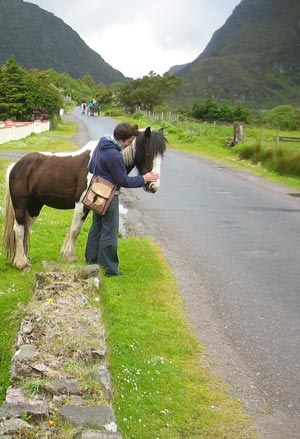
The Gap of Dunloe, Ireland

The Gap of Dunloe, Ireland

The boy and his father stood in the middle of our quiet street. “What are you doing?” I asked.

“Throwing buckeyes!” the kid beamed as he and Dad playfully launched two more down the hill. I watched them in the Saturday sun and fell into a gap.

The world is full of gaps. Opportunity gaps. Credibility gaps. Some shouldn’t be missed, like Ireland’s fantastic Gap of Dunloe. And some, like the one in the London Tube, must be avoided. (Mind the Gap – lest you find yourself floundering between train and platform!)

Ever hear the term gap year? It usually refers to a break taken by high school or college grads that defers enrollment in the next phase of life. Ideally, one uses a gap year to do something completely out of the box: work, volunteer, intern, apprentice, self-study, travel… or any real world offering. The implicit goal is to figure out what you really want or don’t want to do with your life.

In January a couple of years ago, our daughter headed off for a travel adventure in SE Asia while our son and his girlfriend headed to Malaysia to teach English there. They each had vague plans for after. But gaps have a habit of transforming those who venture into them and that’s the whole point. I used their departure to ask myself, “Where can I find some gaps to give me more of what I need this year?” I realized I needed to get back to writing fiction. The result? My Middle School Confidential™ series.

Adults and teens say they want more time to do the stuff they really enjoy. Sounds like a worthy New Year’s Resolution. Instead of waiting for life to slow down how about looking for gaps? I’m not talking about major gaps that require chucking your “real” life for a year. I’m talking about tiny gaps we continuously overlook despite their fluttering, glowing and vibrating all around us. Gaps in the kitchen, in the car… in between gulping coffee and thinking about the next six things you have to do. The doorway into a gap might be the curl of your son’s hair or a bird flying over the freeway. Or… just about anything.

In the spirit of the new year, here’s a challenge. Right here, at your computer, fall into a gap. Go ahead, no one’s watching. As you read these words, stop for a minute. Breathe in… and notice yourself breathing in. Breathe out… and focus on breathing out. (C’mon, play along with me.) Slowly look around the room. Find something familiar and appreciate something new about it. Consciously turn off autopilot and life slows and quiets down a bit. What might happen if you consciously looked for gap moments and, for example, appreciated your children in new ways? How might your experience of parenting change? How about your perception of who you are and what matters to you as an individual?

Just to be clear, I’m not advocating dropping out and contemplating your cuticles 24/7. I’m simply suggesting that life offers more options than stress/productivity vs. nirvana/slackerdom. Look, I’m one of the most productive people I know and proud of it. So believe me when I say that you can find gap moments and still be productive. When I fall into a gap, which I’ve been doing more frequently (I’m in one right now), I simultaneously become calmer and more energized. That opens me up creatively, intellectually, intuitively… and my productivity soars.

I know from my email that teens are stressed. You can help them by finding gap moments in your own life. That can lower your stress levels which will decrease the overall stress in your home. Talk to your kids about the concept of a gap… a momentary break from day-to-day busyness. Model it for them. The payoff? You’ll begin to savor your life on a deeper level. And with your leadership your family will live in time instead of just passing through.

Happy New Year and watch out for flying buckeyes.

In friendship,
Annie

P.S. If you decide to take on my New Year’s Gap Challenge I’d love to hear from you. It doesn’t have to be anything cosmic, just a brief description of a moment when you slowed down and fell into a gap. Maybe I’ll include some of your gap stories in a future blog as inspiration for all of us who could use a break.

Filed under: Holidays,Parenting — Tags: , , , , — Annie @ 6:11 pm
---------

Giving to Get vs. Giving to Give

December 29, 2009

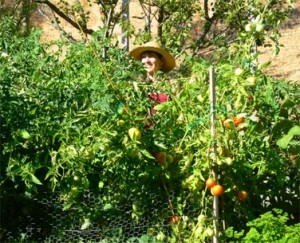
And the tomato gods had a field day

And the tomato gods had a field day

I’m a gardener and by definition that makes me an optimist. Even my farming fizzles don’t deter me from continuing to bury peach pits or old potatoes. Those of you who’ve outgrown playing in the dirt may laugh, but every so often my efforts pay off big time. Like a couple of summers ago when the tomato gods smiled upon us. God did they ever! In fact, they were still laughing their heads off a full week before Halloween. Too bad you can’t carve a tomato.

When it comes to gardening, I’m not ashamed to say that I give only to get. I shower my plants with regular infusions of compost tea and worm castings because I want something in return. I believe that I’m entitled to a major payback for all my efforts otherwise I wouldn’t bother.

When it comes to raising kids, there isn’t really a payback. Not coming directly from them to you. Of course, there are rewards along the way. Like the joy we experience when they succeed at something they’ve worked for. And the pride we feel when our children honor us and themselves by making healthy choices­–especially when we’re not around to prod them. But those perks aren’t why we give to our kids. We’d still do it even if we got nothing to brag about. Why? Because, the simple fact is that we parents are in the business of giving to give. Parenting, unlike marriage, is a one-way street.

Does this mean that you’ll inevitably raise a young adult focused only on her own needs? Hopefully not! Because a big part of what you should be giving your kids is an education about what it means to be thoughtful, loving and compassionate. Hopefully you demonstrate that in the way you treat them. Set clear expectations for the behavior you want them to exhibit and you’ll see more of the good stuff. When you do shower those young ‘uns with praise. And pat yourself on the back. You’re helping to launch a loving spirit into the world.

Now there’s a harvest worth a whole lot more than a basket of tomatoes.

Filed under: Parenting,Tips — Tags: , , — Annie @ 4:59 pm
---------
« Newer PostsOlder Posts »
Follow Annie Fox on Social Media and the Web