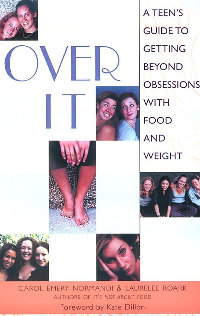
"Over It: A Teen's Guide to Getting Beyond Obsessions with Food and Weight"
Several times a week I receive an email from a desperate 12-16 year old girl who’s having issues about her weight. No, let me rephrase that. Her issue isn’t with the number on the bathroom scale. The issue is how she feels about herself. Typically the girl who writes to me hates her body and the way she looks. Then the whole guilt by associate thing sets in and next thing you know… the girl hates herself!
Here are some recent examples:
I’m a junior in high school and let me just start by saying: being a junior sucks. It’s not just the year itself but me that seems to be the problem. Then there’s the whole body image thing. I know I should be happy with what I’ve got and blah blah blah but I still wish I could get out of the training bra section. It’s so awful having friends tell me that they wish they didn’t develop and I should be happy that I’m flat as a board at 16.
Or this one:
I know that I need to lose 10-15 pounds because I’m 5’3″ and weigh about 130. I think that is too high. All my family members say that I’m a little overweight and I am embarrassed every time they talk to me about it. Maybe I don’t need to lose that much but I still need to lose some.
Or this:
I’m very perplexed. I think I’m fat when everyone tells me I’m not. I’m bulimic but no one knows. How do I stop? Because every time I do try to stop I feel guilty and I become worse. I’m 12 years old and I weigh 75 pounds. I still think I’m fat.
Should we be surprised that these girls are so unhappy with themselves and so out of synch with reality? Considering that they’re growing up in a thin-obsessed culture, it would probably be way more surprising if they didn’tfeel this way! So what’s been going on with American girls and women since the early ‘60’s that causes this crippling dissatisfaction with our looks? What does the steady rise in eating disorders (which now includes boys and men) say about our society and our values? And how do we get over it already and help our daughters and sons do the same?
In this week’s podcast* I talk with Carol Normandi and Laurelee Roark co-authors of “Over It: A Teen’s Guide to Getting Beyond Obsessions with Food and Weight.” We talk about the effects of media and pop culture on the body image, healthy and well-being of our tweens and teens. And what parents can do to fight back.
Have a listen here:
[QUICKTIME http://www.anniefox.com/podcast/FC006.m4a 300 300 false true]
If you have iTunes, you can subscribe to this podcast in the iTunes Store.
Or, you can download an MP3 version here.
Upcoming guests include:
Robert Rummel-Hudson, author of Schuyler’s Monster: A Father’s Journey With His Wordless Daughter
Wednesday Martin, author of Stepmonster: A New Look At Why Stepmothers Think, Feel And Act The Way We Do
Ayelet Waldman, author of Bad Mother: A Chronicle of Maternal Crimes, Minor Calamities, And Occasional Moments of Grace
Izzy Rose, author of The Package Deal: My (not-so) Glamorous Transition from Single Gal to Instant Mom
Diane E. Levin, co-author (with Jean Kilbourne) of So Sexy So Soon: The New Sexualized Childhood And What Parents Can Do to Protect Their Kids
Special thanks to our friend and musician/composer Curt Siffert who let us use his song, “Tie Down for the Storm” for the opening of this podcast.
*What’s a podcast? “A podcast is a series of digital media files, usually either digital audio or video, that is made available for download via web syndication.” — Wikipedia… So, in this case, there’s an audio file for you to listen to (in addition to reading the above).













 Facebook
 Twitter
