|
|
November 20, 2012
The following is an excerpt from my new parenting book, Teaching Kids to Be Good People. It’s from the chapter on Emotional Intelligence.
 If you try you might get what you need Right before Thanksgiving a few years back, my dear friend Bettina, who was having some health issues, emailed me: “I know this is incredibly presumptuous and Miss Manners would be scandalized, but I’m wrangling for an invitation.”
I was blown away. Not by her directness (God no!), but by her feeling that she had no right to say, “I’m not feeling well and I don’t want to be alone. Can I come over?” Immediately I called and thanked her for trusting me to understand her vulnerability. I also gave her top marks for the way she had honored herself by asking for what she needed. She was relieved to hear that she’d done the right thing by speaking up.
Most of us are much quicker to stand up for others than for ourselves. On some level we must believe we don’t deserve to get our emotional needs met. But where does that foolishness come from? Here’s my theory . . .
Babies are irresistibly cute so adults fall hard and take good care of them. Once they’ve gotten their sweet baby hooks into our hearts, they are experts at expressing their physical and emotional needs, nonverbally. As our children grow, our conversations with them center mostly on the physical aspects of life: Sweetheart, are you hungry? Do you want something to drink? Is it nap time? Why don’t you put on a sweater? As a result, asking for tangible stuff is very easy for kids: Dad, I need a ride. Mom, I need you to sign this. I need a new phone. I need money.
Because most parents don’t teach kids about expressing emotional needs, teens rarely say: I need a hug. I need to share this exciting news! I need you to listen. I need you to tell me the truth. I need help.
I asked a bunch of sixth–eighth graders to rate themselves on these two statements: “It’s easy for me to ask for help” and “I pretend things are OK when they aren’t.” The results? Twenty-five percent of the kids said it was “never or almost never” easy to ask for help. Another 25 percent reported that “sometimes” they had trouble asking for help. And here’s another sad finding: A whopping 83 percent admitted that “sometimes, always, or almost always” they pretend things are OK when they aren’t.
An unwillingness to ask for help, coupled with a habit of pretending things are fine when they’re not, is unhealthy. When we deny our human need to connect heart-to-heart, we end up short-changing ourselves and the people we’re closest to.
A parent’s role is to raise an emotionally healthy young adult. That includes helping a child recognize what s/he’s feeling and learning to ask for support when needed. Of course self-reliance is essential and being able to calm yourself at times of stress is a life skill, but there’s no denying that we all feel vulnerable at times. It’s also true that we’re all interdependent. When we let people know how we feel and allow them to love us and help us, we honor our humanity. We do the same when we love and help others.
On that Thanksgiving, my family and I were heading out of town, so our home was going to be cold and dark. I couldn’t offer Bettina a warm place at our table. But with my encouragement, she was confident enough to express her needs to another friend who gladly opened his heart and home. What would surely have been a sad and lonely day for her, turned into a wonderful occasion. Less than two years later, Bettina died. Thinking about her, then and now, I’m comforted knowing that she wasn’t alone on one of her last Thanksgiving holidays. She was brave enough to reach out and ask for what she needed. Bettina taught me a powerful lesson, especially important when we’re vulnerable: When it comes to friends and family, hold nothing back. Allow yourself to love and be loved fully, without limits.
Happy Holidays, from our family to yours.

January 17, 2012
(See UPDATES BELOW)
I’m writing my first book for adults since Armchair BASIC. It’s called: Teaching Kids to Be Good People. It will be available as an eBook in September.
Since one person’s “good” might be another person’s “Are you kidding me?!” I knew I needed to be precise from the onset. So I asked my twitter followers, plus many of my most thoughtful friends, colleagues and family members “How do you define a ‘good’ person?”
Lots of intriguing and insightful responses galloped my way and I’m grateful. My plan is to dissect each one… all in good time. But at the moment, I’m focused on forgiveness.
That’s an aspect of “goodness” I hadn’t considered. Probably says something about me. I mean, I have overstayed my welcome at the Self-Pity Party, ahem… once or twice. So when one especially kind-hearted friend offered me this nugget: “A good person is forgiving”, like a dog and a flying tennis ball, I was on it. Thinking. Thinking. Thinking.
- What does it mean to be forgiving?
- How do you actually forgive someone? Which muscle do you relax or clench?
- What’s the connection between forgiving and forgetting? Are they mutually exclusive?
- What might you gain by holding on to your resentment? Anger? Self-righteous indignation?
- What might you lose?
- Why is it so $#*@ hard to permanently unplug a memory that continues to wound each time you project it onto your mental movie screen?
These are open ended questions, my friends. I don’t know any useful answers… yet. Love to hear your thoughts.
fyi, in the next 6 months, I’ll be talking about teaching kids to be good people at the 18th Annual Character Education Conference in St. Louis, the INTASE Educators’ Conference in Singapore, and at the 19th National Forum on Character Education in Washington, DC.
_______________
UPDATE 3:13 pm Today (9/14/12): The book is finished! And I’ve had only enthusiastic early reviews, including these:
- “Annie Fox has a genuine passion for helping our young people and she has many years of experience doing it. Both are evident in this wonderful resource for parents and teachers. It’s full of insight, wisdom, good stories, and most important – practical advice. I highly recommend it for anyone wanting to help our kids become good people.” –Dr. Hal Urban, author of Life’s Greatest Lessons and 20 Gifts of Life
- I can’t express enough how much I love Annie’s work. Having worked in this field for so long, it becomes increasingly difficult to read new thoughts and ideas. Every time I read something of Annie’s, it makes me think. She writes about subjects with such compassion, insight and practicality that you can’t help but love all that she does. Great book-a great job Annie!” –Sarah Newton, author of Help! My Teenager is an Alien!
- “Another work of magic from what I have come to know as a master in the field. Sharing actual scenarios and follow up ideas, helps to keep readers connected to Annie’s ideas in a way that most parenting books fail to do.” –Joe Bruzzese, author of A Parents’ Guide to the Middle School Years and Founder of Sprigeo.com, the online bully reporting system
- “Finding positive, empathetic role models is often difficult but this wonderfully practical and warm hearted eBook is a great place to start. It will empower parents with some really helpful suggestions and ideas that will help you to navigate the choppy emotional waters of raising great adults.” –Sue Atkins, author of Parenting Made Easy – How to Raise Happy Children
This early feedback, especially coming from these excellent parent educators, has touched and encouraged me. The book is done, so what am I waiting for? Nothing, except to finalize the cover design. That won’t take long. As promised, before the sun sets on the last day of September 2012, Teaching Kids to Be Good People, will be available to everyone interested in raising young adults of good heart and mind. If you’d like to receive an announcement when the book is available, shoot me an email and I’ll let you know… personally.
_____________
UPDATE (10/3/12): I’m very pleased (and excited) to announce Teaching Kids to Be Good People is now available in print and also on Kindle. Here’s an excerpt from the introduction:
We parent-educators are gardeners. We plant seeds and offer nurturing lessons that our kids can internalize. But we are not our children’s only influencers. By re-dedicating ourselves to teaching our kids to be good people, we provide them with the tools to do the right thing while we’re right there beside them and when they’re on their own. Whether they actually do it, is their choice. But at least we’ll know we’ve done our part well.
To help on our parenting journey, I’ve written this very personal and pragmatic guide that includes essays, podcasts, prompts, tools, questions, answers and self-assessment quizzes all for the purpose of teaching kids to be good people. How do you define a “good person?” That’s what I wanted to find out, so I posted the question and received hundreds of answers. Eight words kept reappearing: Emotional intelligence, ethics, help, forgiveness, compassion, empathy, tolerance and social courage — all essential, teachable skills. This book will help you teach them to your children or students. Hopefully, we’ll become so engaged in this process that our teaching will inspire all of our children to become part of the solution.
Look for an announcement next month! In the meantime, if you’d like a personal email when the Teaching Kids to Be Good People is available, let me know.
June 22, 2011
Summer is the time for letting loose. But when things get too loose, well… you might find yourself in an embarrassing situation. Like the girl who wrote to me the other day:
 OMG!! Hey Terra,
Me and my friends were at the pool and I was taking off the shorts I was wearing over my bikini. The side ties must have untied because my bikini started to slip off with my shorts! People say they saw part of my butt and my front part. I AM SOOO ASHAMED & EMBARRASSED. HELP!
Seriously Upset
Dear Seriously Upset,
That was an embarrassing moment… for sure. I understand. What happened isn’t something you chose and it’s certainly not something you expected. Call it a “wardrobe malfunction”… it happens to everyone at times. And that time it happened to you. I’ve got no Time Machine so I can’t help you un-do this, but you’ve got choices moving forward (the only direction the road goes in Life). You can:
a) Spend the rest of the summer hiding out in your room or only go out with a well-ventilated paper bag over your head.
b) Sew or staple the bikini ties so they can’t come undone. If the top has ties too, Super Glue them together.
c) Wear a one piece bathing suit (do they still sell those?) Or a two piece that doesn’t have ties.
d) Go out tomorrow with your friends and get seriously upset with anybody who talks about what happened. Yell at them and make a huge scene. Not that you want to embarrass yourself again but…it’ll give them something to talk about!
e) Hold your head up high because you didn’t actually DO anything to be ashamed of. When/if someone brings up the bikini incident (and someone might) just pretend you’re an Academy Award winning actor who’s in total control of her performance. LAUGH WITH THEM and in between giggles and a series of cute hair flips say, “OMG! That was totally embarrassing!!” In other words… take charge because, Sweetie, no one can make you feel humiliated without your permission.
It’s your life. Your choice. Which one do you pick?
In friendship,
Terra
UPDATE: Seriously Upset wrote back today and told me she chose “e”. She went on to say “I just smile and laugh and get over it because it was a few days ago and now it’s old news.”
Smart girl!
November 9, 2009
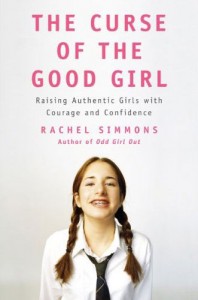 The Curse of the Good Girl by Rachel Simmons If you live or work with teen girls you don’t need me to tell you they can be way out there with their emotions. And you already know that girl friendships can be fraught with drama, misunderstandings, betrayals and recriminations. Which proves that being emotional doesn’t automatically translate into high Emotional Intelligence. (EQ, AKA getting real with yourself so you can be real with the people you’re close to. )
When teen girl emotion explodes around parents, they often do what moms and dads of my parents’ generation did… try to contain and sanitize the feelings. Why? Perhaps some parents sincerely believe that people who are too emotional get clobbered by life. Another possibility is that when confronted with a girl’s outburst that parents can’t “fix” the next best solution is to try to shut it down as quickly as possible. Either way the message is that some emotions are just not the “good girl” kind.
If a girl expresses sadness she may hear: “Cheer up. It can’t be all that bad!”
If she expresses fear she might get: “There’s nothing to be afraid of!”
If she rages over some real or imagined injustice she may be treated to some variation of this 20th century chestnut: “Better watch it, young lady. You’re getting a little too big for your britches.”
When I was a child, the most powerful phrase I knew was “Shut up!” Only used in a rare moment of frustration and laughably tame by today’s standards, those words were consistent show stoppers in my family and always followed by: “That language is unacceptable.” I realize now that it was my assertiveness that was truly unacceptable.
21st century parental messages to girls haven’t changed all the much: Don’t be sad. Don’t be scared. Don’t be angry. Oh, and while you’re at it: Don’t be shy. Don’t be worried. Don’t be embarrassed. Don’t be so silly. Don’t be so dramatic. Don’t be so smart.
If girls can’t be any of those things, what, in heaven’s name, are they supposed to be? Duh! They’re supposed to be GOOD! At all times sweet, loving and cooperative. Modest, supportive, nurturing, generous and nice. But what are girls expected to do when any of those other not so good and not so nice feelings pop up? No problem. If you want to be a good girl (Yes, please!) you learn to stuff it and smile.
In this week’s podcast I talk with Rachel Simmons, author of The Curse of the Good Girl: Raising Authentic Girls with Courage and Confidence. And what a terrific and important book it is. Here’s an excerpt:
________
To deepen your vision for your daughter, write her a letter (you don’t have to send it) and explore these questions:
- What do you wish you had known when you were her age? Think about the girl you used to be and the woman you are today. Focus on what you have learned about relationships, conflict, and self-confidence.
- What does being yourself mean to you?
- What did the female role models of your childhood teach you? If you did not have any, what do you wish you might have learned from a caring adult woman?
You have learned many lessons in your life. By defining them for yourself, you can begin thinking about how to convey practical wisdom to your daughter, in both what you say and how you act.
____________
Listen to my interview with Rachel Simmons right here:
[QUICKTIME http://www.anniefox.com/podcast/FC011.m4a 300 300 false true]
If you have iTunes, you can subscribe to this podcast in the iTunes Store.
Or, you can download an MP3 version here.
Upcoming guests include:
Rosalind Wiseman, author of Queen Bees & Wanna Bees and Queen Bee Moms & Kingpin Dads
Izzy Rose, author of The Package Deal: My (not-so) Glamorous Transition from Single Gal to Instant Mom
Diane E. Levin, co-author (with Jean Kilbourne) of So Sexy So Soon: The New Sexualized Childhood And What Parents Can Do to Protect Their Kids
Susan M. Heim, author of It’s Twins! and Chicken Soup for the Soul Twins and More
Hannah Friedman, author of Everything Sucks: Losing My Mind and Finding Myself in a High School Quest for Cool
Dara Chadwick, author of You’d Be So Pretty If…
*What’s a podcast? “A podcast is a series of digital media files, usually either digital audio or video, that is made available for download via web syndication.” –Wikipedia… So, in this case, there’s an audio file for you to listen to (in addition to reading the above).
— Older Posts »
| |













 Facebook
 Twitter
