|
|
December 4, 2013
Lots going on this time of year. (Props for taking time to read a blog.) We feel pressure to make the holidays “perfect.” Pressure to spend. Pressure to save. Pressure to get the kids to behave. We all have moments when we trade “nice” for B#$@%. We’re human and we get stressed. But when we show more Beast than Loving Parent, we are damaging our children. That’s a problem that keeps making problems. The good news? We are key to the solution.
The following article is an excerpt from my book: Teaching Kids to Be Good People (If you’re interested, it’s 50% off for the holidays Code 3MZQS83F)
I had the pleasure of interviewing Rachel Simmons the Wise for my podcast series. We talked about her book The Curse of the Good Girl: Raising Authentic Girls with Courage and Confidence. We also discussed how often parents engage in meta-conversations with their children (i.e., parent says one thing and an unspoken message churns just below the surface).
With all that doublespeak how can a t(w)een learn to be authentic and express the truth of her heart? Not very easily. And it isn’t just parents and daughters. As Rachel put it, no matter who you’re talking to or what relationship you’ve got, “there’s always a meta-conversation going on.”
Parent: Oh, you’re still playing that game.
Meta-message: I just know you won’t get your homework
done tonight and then what? You think I like being on your case? Well, I don’t! But if I don’t keep after you how are you ever going to get into a decent college?
Mini meta-message: You’re lazy and I’m disappointed in you.
________
Parent: Don’t you think your other jeans would look better with that top?
Meta-message: Those jeans are too tight and too low cut. They make you look fat and slutty. What will Grandma say when she sees you wearing that? She’s going to think I’m a terrible mother to let you dress that way!
Mini meta-message: You’re fat and you embarrass me.
________
Parent: How’s your buddy Ryan these days?
Meta-message: Are you two still friends? Did something
happen between you? Are you now hanging out with people I should be worried about? (Sigh) You and I used to be able to talk about stuff. Now you don’t tell me anything. What else are you hiding from me? Maybe I don’t even want to know!
Mini meta-message: You’re disloyal and untrustworthy.
________
I’ve been thinking about meta-messages and how I use them. Whether they’re conscious or not, communication patterns between people often determine who we like to hang out with and who doesn’t make our FAVS list.
 Josie 2009-2012 During the holidays a few years back, Josie and I snuck out of the house before anyone else was up. Because she was still full of puppy beans and needed her off-leash time, we headed for the nearby hills. She instantly vanished through the trees tracking deer and squirrels and nosing the underbrush for ticks thumbing a ride. While she was gone I walked on, enjoying the quiet light and the colors. Every so often I’d whistle for Josie and she’d reappear, sometimes from behind me on the trail, sometimes way ahead. We’d smile at each other and wag our tails. “Yes! Good dog!” Then I’d give her a treat. After each reunion she’d take off again and I continued hiking.
So it went for an hour. When I finally put her back on leash I thought about the meta-conversation we had and why Josie happily kept returning to me. The way I figure, it comes down to this . . . each of us, dog and human, prefers to hang with those who tell us we are good dogs.
It also helps if they give us treats.
_______________
We’re in the darkest days of the year, so how about lightening up? Catch someone you love in the act of doing something right. Drop the meta-messages and smile.

November 29, 2009
 That's a good dog A couple of weeks ago I interviewed Rachel Simmons The Wise for my podcast series Family Confidential. We talked about her new book: The Curse of The Good Girl: Raising Authentic Girls With Courage and Confidence. We also discussed how often moms engage in meta-conversations with their daughters (i.e., Mom says one thing and a fingertip below the surface churns the unspoken message). With all that doublespeak how can a girl learn to be authentic and express the truth of her heart? Not very easily. And it isn’t just moms and daughters. As Rachel put it, no matter who you’re talking to or what relationship you’ve got, “… there’s always a meta-conversation going on.”
For example:
Parent: Oh, you’re still on the phone.
Meta-message: I just know you won’t get your homework done tonight and then what? You think I enjoy nagging you? Well, I don’t! But if I don’t stay on your case how are you ever going to get into a decent college??
Mini meta-message: You’re lazy and I’m disappointed in you.
Parent: Don’t you think your other jeans would look better with that top?
Meta-message: Those jeans are too tight and too low cut. They make you look fat and slutty. What will Grandma say when she sees you wearing that? She’s going to think I’m a bad mother to let you dress that way!
Mini meta-message: You’re fat and you embarrass me.
Parent: How’s Janie these days?
Meta-message: Are you two still friends? Did you hurt her feelings or do something to make her mad? Are you now hanging out with people I should be worried about? (Sigh) You and I used to be so close. Now you don’t tell me anything. What else are you hiding from me? I’m not sure I even want to know!
Mini meta-message: You’re not a good friend and I don’t trust you.
Visiting with family and friends this holiday weekend I’ve thought about meta-messages. And whether they’re conscious or not, communication patterns between people often determine who we like to hang out with and who doesn’t make our “favorites” list.
Early this morning me and my dog Josie snuck out of the house before anyone else was awake. We headed for the nearby hills and because Josie’s only 8 months old and full of beans I let her off-leash. She instantly vanished through the trees tracking deer and squirrels and nosing the underbrush for ticks thumbing a ride to our house. While she was gone I walked on, enjoying the quiet light and the colors. Every so often I’d whistle for Josie and she’d reappear. Sometimes from behind me on the trail. Sometimes from way ahead. We’d smile at each other and wag our tails. “Yes! Good dog!” Then I’d give her a treat. After each reunion she’d take off again and I continued hiking.
So it went for about an hour. When I finally put her back on leash I thought about the meta-conversation Josie and I had and why she happily kept returning to me. The way I figure, it comes down to this… each of us, dog or human, prefers to hang with people who tell us we are good dogs.
It also help if they give us treats.
November 9, 2009
 The Curse of the Good Girl by Rachel Simmons If you live or work with teen girls you don’t need me to tell you they can be way out there with their emotions. And you already know that girl friendships can be fraught with drama, misunderstandings, betrayals and recriminations. Which proves that being emotional doesn’t automatically translate into high Emotional Intelligence. (EQ, AKA getting real with yourself so you can be real with the people you’re close to. )
When teen girl emotion explodes around parents, they often do what moms and dads of my parents’ generation did… try to contain and sanitize the feelings. Why? Perhaps some parents sincerely believe that people who are too emotional get clobbered by life. Another possibility is that when confronted with a girl’s outburst that parents can’t “fix” the next best solution is to try to shut it down as quickly as possible. Either way the message is that some emotions are just not the “good girl” kind.
If a girl expresses sadness she may hear: “Cheer up. It can’t be all that bad!”
If she expresses fear she might get: “There’s nothing to be afraid of!”
If she rages over some real or imagined injustice she may be treated to some variation of this 20th century chestnut: “Better watch it, young lady. You’re getting a little too big for your britches.”
When I was a child, the most powerful phrase I knew was “Shut up!” Only used in a rare moment of frustration and laughably tame by today’s standards, those words were consistent show stoppers in my family and always followed by: “That language is unacceptable.” I realize now that it was my assertiveness that was truly unacceptable.
21st century parental messages to girls haven’t changed all the much: Don’t be sad. Don’t be scared. Don’t be angry. Oh, and while you’re at it: Don’t be shy. Don’t be worried. Don’t be embarrassed. Don’t be so silly. Don’t be so dramatic. Don’t be so smart.
If girls can’t be any of those things, what, in heaven’s name, are they supposed to be? Duh! They’re supposed to be GOOD! At all times sweet, loving and cooperative. Modest, supportive, nurturing, generous and nice. But what are girls expected to do when any of those other not so good and not so nice feelings pop up? No problem. If you want to be a good girl (Yes, please!) you learn to stuff it and smile.
In this week’s podcast I talk with Rachel Simmons, author of The Curse of the Good Girl: Raising Authentic Girls with Courage and Confidence. And what a terrific and important book it is. Here’s an excerpt:
________
To deepen your vision for your daughter, write her a letter (you don’t have to send it) and explore these questions:
- What do you wish you had known when you were her age? Think about the girl you used to be and the woman you are today. Focus on what you have learned about relationships, conflict, and self-confidence.
- What does being yourself mean to you?
- What did the female role models of your childhood teach you? If you did not have any, what do you wish you might have learned from a caring adult woman?
You have learned many lessons in your life. By defining them for yourself, you can begin thinking about how to convey practical wisdom to your daughter, in both what you say and how you act.
____________
Listen to my interview with Rachel Simmons right here:
[QUICKTIME http://www.anniefox.com/podcast/FC011.m4a 300 300 false true]
If you have iTunes, you can subscribe to this podcast in the iTunes Store.
Or, you can download an MP3 version here.
Upcoming guests include:
Rosalind Wiseman, author of Queen Bees & Wanna Bees and Queen Bee Moms & Kingpin Dads
Izzy Rose, author of The Package Deal: My (not-so) Glamorous Transition from Single Gal to Instant Mom
Diane E. Levin, co-author (with Jean Kilbourne) of So Sexy So Soon: The New Sexualized Childhood And What Parents Can Do to Protect Their Kids
Susan M. Heim, author of It’s Twins! and Chicken Soup for the Soul Twins and More
Hannah Friedman, author of Everything Sucks: Losing My Mind and Finding Myself in a High School Quest for Cool
Dara Chadwick, author of You’d Be So Pretty If…
*What’s a podcast? “A podcast is a series of digital media files, usually either digital audio or video, that is made available for download via web syndication.” –Wikipedia… So, in this case, there’s an audio file for you to listen to (in addition to reading the above).
October 14, 2009
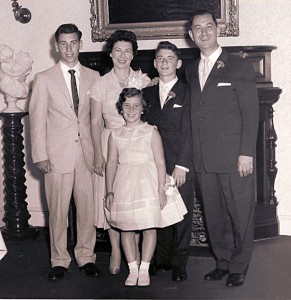 As we were in 1959 Today I interviewed Rachel Simmons for my podcast series: Family Confidential: Secrets of Successful Parenting. (No, it’s not posted yet. Gimme a week or two, ok?) We talked about her must-read new book The Curse of the Good Girl: Raising Authentic Girls with Courage and Confidence and about emotional intelligence. For me, EI (aka EQ) is the ability to:
- identify what you’re feeling
- accept the emotion as it is (without editorializing about your right to feel it)
- express emotion in responsible ways to people who need to hear what you have to say
I’ve immersed myself in this stuff for decades and love talking with people like Rachel, who’ve also made EI their life’s work.
After the interview I recalled a 2003 keynote speech I delivered in Los Angeles. The title: Why 21st Century Kids Need 21st Century Parenting. This feels as good a time as any for a revisit. Here’s a excerpt:
Before we were parents we had parents. People who showed us what it took to be a mom and a dad.
I woke up one morning when I was 5 and heard my mother sobbing behind the door of her room, my father comforting her. My brothers told me that Grandpa had died. A while later, Mom emerged, hair freshly brushed, lipstick bright red. She cheerfully asked what I wanted for breakfast. I wasn’t hungry, I was confused. I wanted to ask about Grandpa, but Mom’s tight smile warned me not to say anything that might upset her. While I pushed a piece of French toast around my plate I had a realization–an absolute epiphany: To be a grown-up means that you have to hide your sadness!
When I was 15 my father died suddenly of a heart attack. His passing left a huge hole in my heart, but instead of grieving I did what I thought grown-ups do, I suppressed my sadness.
Fast-forward 25 years. I’m in the dentist’s chair getting a replacement for an old childhood filling. The doctor pauses in the procedure, gently rests a hand on my head and asks how I’m doing. At his touch a tidal wave of sadness overwhelms me and I start weeping. For the next 48 hours I’m emotionally numb and clueless about what the hell is happening.
David helped me realize that the dentist’s touch had reminded me of my father, who often tousled my hair. With that revelation, the floodgates burst… finally I was able to grieve for my dad. And through my expression of loss I released myself from feelings which held me hostage for decades.
That day I learned about the power of unexpressed emotions. They don’t actually ever go away. Instead, they work like a mild acid, slowly eroding your insides, boring holes in your emotional foundation, creating gaps in your ability to connect with others. I decided not to ever bury feelings that need to be expressed. I vowed to teach my children, through my own example, to express their emotions in healthy ways.
I got my chance soon enough. During most of 1994 my mom was dying of Lou Gehrig’s Disease. Every day I drove an hour each way to visit her. During endless games of Scrabble we finally found the words to communicate with an intimacy we’d never shared before. I am eternally grateful for those last 10 months we had together… grace-filled and excruciatingly painful as they were.
After spending the day with Mom I’d arrive home each night to my own family, scared, stressed, worn down and so raw. I offered no one a lipstick smile. Instead, I trusted that our daughter and son (then ages 15 and 9) would know how to respond to a person in need. And they did. Their backrubs, cups of tea and loving words of encouragement got me through that endless year. I don’t know how I’d have coped if not for David and our sweet kids. If I’d chosen to play the game of “Everything’s fine, honey” I’d have betrayed myself and robbed my children of an opportunity to learn what it means to be a real human being. By sharing the truth of my emotional experience I gave them the chance to exercise their compassion (toward me and their grandmother) and to grow beautifully toward adulthood.
For years we’re on the receiving end of our parents’ choices, observing closely everything they do. As little children we accept that they knew best about what we need. As teens we wonder if they’ve got a clue about who we were or how to parent. After all that watching and evaluating and on the job training with kids of our own, at this point, what could we possibly not know about being a parent?
We know it all, right?
| |












 Facebook
 Twitter
